
After your trial, you'll switch to our Free Plan and will not be charged. Stay tuned to your inbox for Bondfish tips and highlights.
Denominated in €, $, £, Fr. Our current spotlight is on the universe of bonds denominated in Euros, US Dollars, British Pounds, and Swiss Francs.
Favorable risk-to-return ratio. In our assessment, the bonds highlighted present tolerable credit risk while offering yields that stand out compared to bank deposits and other bonds.
Accessible Investment Sizes. The bonds are available for trading in smaller, more manageable lots of up to 1,000 EUR or equivalent.
Market Liquidity. We prioritize bonds that are widely accessible through numerous brokers and exhibit active trading with consistent bid and ask quotes.
For each broker we analyse five categories: selection of tradable bonds, trading and custody costs, safety (regulation, capital protection, deposit guarantee), platform experience, and extras such as tax handling, multi-currency accounts or customer service. Within each category we compare brokers on 28 specific criteria and assign a points score; the maximum total is 100 points.
We then convert the overall score into a rating from 0 to 5, where 5.0 represents the maximum possible, using the formula: points awarded / 20 (rounded to one decimal place). This gives the following scale:
| Points awarded | Rating | Test result |
|---|---|---|
| 90 – 100 | 4.5 – 5.0 | Excellent |
| 78 – 89 | 4.0 – 4.4 | Very good |
| 60 – 77 | 3.0 – 3.9 | Good |
| 40 – 59 | 2.0 – 2.9 | Sufficient |
| 20 – 39 | 1.0 – 1.9 | Adequate |
| 0 – 19 | 0 – 0.9 | Poor |
| Category | What it measures | Weight |
|---|---|---|
| Selection | Number and variety of tradable bonds (corporate, sovereign, multi-currency) | 25% |
| Costs | Trading, custody and inactivity fees | 20% |
| Platform | Bond screener, ISIN search, limit orders, usability | 20% |
| Safety | Regulation, banking licence, deposit guarantee | 15% |
| Extras | Tax handling, savings plan, interest on cash, bond ETFs | 20% |
We are currently developing the advanced features of our Professional Plan.
Join our waiting list to get early access and enjoy a free trial when we launch!
By switching to the Basic plan, you will:
Note: You will continue to enjoy Premium features until . You can switch back to the Premium Plan at any time to regain access to all the exclusive features and content.
This page has not been translated into the selected language.
To calculate yield after tax, we need to know your country of tax residence:
This feature is currently supported only for residents of:
If you are a resident of Italy, please update your country in your User Profile settings.
The format we use to display the name of a bond is as follows: “Issuer Name”, “Current Coupon Rate”, “Maturity Date (mm-yyyy)”.
The return you would get if you bought at a given price and held to maturity, expressed on an annualised basis. If the bond has embedded options (i.e. put or call options), the yield is calculated to the worst possible outcome for you.
The difference in before-tax return between an investment in a bond and an investment in a bank deposit, both with the same maturity and in the same currency, assuming the bond is held to maturity. The benchmark deposit rate used for comparison depends on the currency of the bond and is derived from fixed-term deposits available in the following countries:
For the benchmark deposit rate, we use indicative bank deposit rates from central banks. When central bank statistics are significantly delayed, we rely on actual deposit rates from leading banks within the selected country where possible.
The best available clean price at which a bond can be bought.
The term 'firm price' refers to the price that closely approximates the ask price seen from brokers known to us who trade the bond. It is calculated as the average of the best ask prices at market close on the most recent trading day, from the most liquid exchanges where the bond was actively traded. Selecting this option enhances your confidence in matching the price when accessing your broker's application
Proceeds from the bond issue are used to finance environmentally friendly projects, such as reducing carbon emissions or mitigating the effects of climate change
When this option is selected, the screener excludes Subordinated and Senior non-preferred bonds.These bonds rank lower in the repayment order and carry higher risk.
Only Senior and Secured bonds remain visible, which generally have higher priority in case of issuer default.
When this option is selected, the screener excludes bonds that do not pay regular interest. Only bonds with periodic coupon payments remain visible.
Zero-coupon bonds are issued at a discount and repay their full face value at maturity. The investor’s return comes from the difference between the purchase price and the redemption amount.
Example: A 5-year zero-coupon bond bought for €800 and redeemed at €1,000 will generate €200 of income at maturity. This corresponds to an annualized return of approximately 5%: (€1,000 – €800) / €800 / 5
The estimated annualised return if you bought the bond at the current market price and held it to maturity, after applying the applicable tax rate.
Formula:
Yield after tax = Yield × (1 − applicable tax rate)
The tax rate is determined by the country of tax residence selected in your user settings.
In jurisdictions where multiple tax rates apply (e.g. preferential rates for certain bond types), the relevant rate is applied. If a bond benefits from a lower tax rate than the standard base rate, the after-tax yield is highlighted in green.
Important:
This calculation is indicative and based on general assumptions. Individual tax circumstances may differ. Bondfish does not provide tax advice and cannot account for all personal factors. Please consult a qualified tax advisor before making investment decisions.
When enabled, the Yield column displays the estimated yield after tax instead of the gross yield.
Formula:
Yield after tax = Yield × (1 − applicable tax rate)
The applicable tax rate is determined by the country of residence selected in your user settings.
In certain jurisdictions (e.g. Italy), tax rates may vary depending on the bond type. Where relevant, the appropriate rate is applied. If a bond benefits from a tax rate lower than the standard default for that country, the after-tax yield is highlighted in green.
Important:
This calculation is indicative and based on general assumptions. Individual tax circumstances may differ. Bondfish does not provide tax advice and cannot account for all personal factors. Please consult a qualified tax advisor before making investment decisions.
Eligible for 12.5% tax rate:
The time to maturity of a bond from today, expressed in years.
An assessment of a borrower's creditworthiness, or the likelihood that the borrower will pay its debts and not go bankrupt.
Credit risk level is based on the average publicly available credit ratings of the issuer and its bonds assigned by the major rating agencies: S&P, Moody’s, and Fitch.
An assessment of a borrower's creditworthiness, or the likelihood that the borrower will pay its debts and not go bankrupt.
We calculate the average publicly available bond and borrower credit rating assigned by global rating agencies and present it on a five-point scale with the following meaning:
The country in which a borrower's main business is located, either in terms of assets or sources of income.
The high-level type of industry in which the borrower of a bond operates.
Brokers and banks known to us that allow you to trade the bond you are looking at on their platform.
The minimum tradable amount for a bond, expressed in the bond’s currency. This is not relevant if the broker allows you to trade fractions of bonds (Trade Republic is an example).
International Securities Identification Number (ISIN) is a globally recognized unique identifier for a security. Click on it to copy it to the clipboard and look it up with your broker.
We offer two different types of pricing data, both calculated in-house: 'firm price' and 'indicative price'.
The 'firm price' is based on the lowest ask price from the previous day’s trading session taken from the exchanges listed below and adjusted for the liquidity level of the venue specific to the instrument.
Exchanges used to calculate the 'firm price':
The 'indicative price' is generated by our unique pricing model, which aggregates data from multiple sources to estimate a value for the instrument on the last trading day. This model incorporates multi-factor analysis, taking into account aspects such as trading volume at relevant venues, randomised factors and a pre-defined maximum variance.
Please note that the pricing data provided by Bondfish is proprietary and may not be redistributed without explicit permission.
The classification of a bond that indicates the order of priority for repayment in the event of the issuer's bankruptcy:
A bond is considered liquid if, based on data from our partner brokers:
Shows bonds with a purchase price below 100 (below face value).
If you buy a bond below 100 and hold it until maturity, it is usually repaid at 100.
The difference is a capital gain.
Example:
Buy at 95, receive 100 at maturity → +5 capital gain.
In some countries, capital gains can be used to offset previously realized investment losses.
Example:
An investor previously sold shares with a loss of 5.
He buys a bond at 95 and holds it to maturity.
The +5 capital gain can offset the earlier −5 loss, so no tax is paid on the gain.
This improves the net return.
Home Depot's $18.25 billion acquisition of SRS Distribution has caused a significant bond yield decrease, indicating a strategic shift towards professional customers amid a sluggish home improvement market.
The SRS Distribution 6% Dec 2029 USD bond (US78471RAD89) has experienced a notable shift in its yield, decreasing by 216 basis points to 5.4% over the last three weeks.
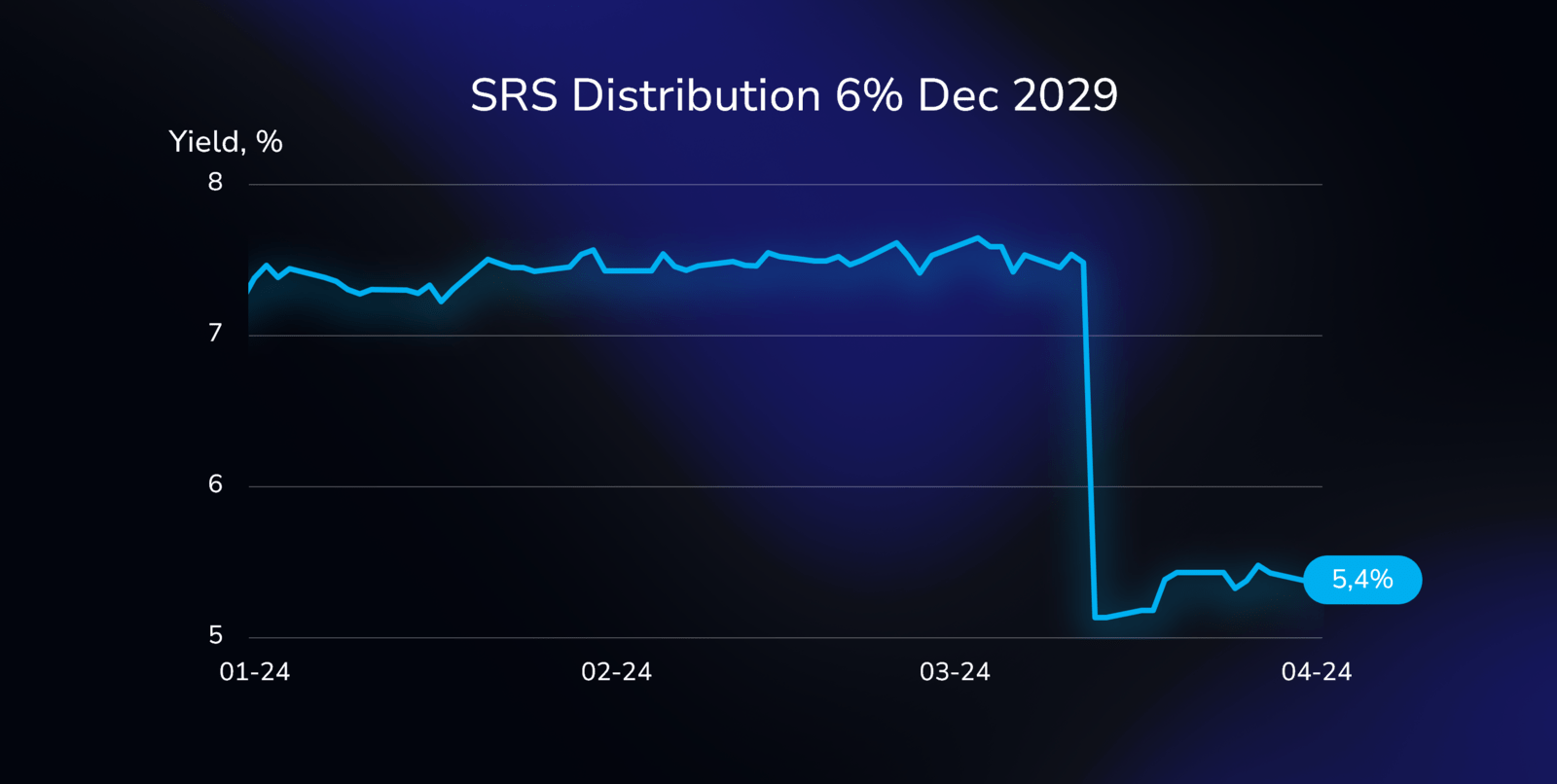
The substantial decline in the bond's yield can be attributed to the recent acquisition announcement made by Home Depot, the leading U.S. home improvement chain. Home Depot unveiled its intention to acquire SRS Distribution in an $18.25 billion deal, including debt. This strategic move aims to bolster Home Depot's position within the professional customer segment, amidst a backdrop of sluggish demand in the home remodeling and renovation market.
The acquisition marks Home Depot's largest deal to date, signifying a strategic shift towards catering to professional builders, contractors, and handymen, collectively known as "Pro-customers." SRS Distribution, currently a portfolio company of private equity firms Leonard Green & Partners and Berkshire Partners, specializes in serving Pro-customers such as roofers, landscapers, and pool contractors.
Ted Decker, CEO of Home Depot, expressed confidence in the acquisition, highlighting SRS's robust platform and its potential to accelerate growth within the residential professional customer segment. The deal will integrate SRS's extensive network of over 2,500 professional sales force and 760 locations into Home Depot's existing footprint of more than 2,000 U.S. stores and distribution centers.
This strategic move not only expands Home Depot's total potential market by approximately $50 billion but also underscores the company's commitment to navigating challenging market conditions by diversifying its customer base and revenue streams.
SRS Distribution's senior unsecured debt is rated 'Caa2' by Moody’s and 'CCC' by S&P, while Home Depot's holds an 'A' rating from Fitch and S&P, along with an 'A2' rating from Moody's. Home Depot plans to deleverage over 24 months to its 2x leverage target by pausing share repurchases to pay down acquisition debt.
The Yield Map for SRS Distribution bonds denominated in USD as of April 16, 2024:

Established in 2008 and based in McKinney, Texas, SRS has swiftly emerged as one of the most rapidly expanding distributors of building products in the United States. From its inception, the company has pursued a unique growth strategy and fostered an entrepreneurial ethos centered around customer service, supplier collaboration, and talent acquisition. Presently, SRS operates under a diverse array of localized brands, spanning over 760 locations across 47 states.
The Home Depot, Inc. is involved in the retail of building materials and home improvement goods. Its extensive range comprises building materials, home improvement essentials, lawn and garden items, as well as decor products. The company's operations are structured across distinct geographical regions, including the U.S., Canada, and Mexico. In addition to its product offerings, it provides installation services for home improvements and facilitates tool and equipment rental. The company traces its origins back to June 29, 1978, when it was founded by Bernard Marcus, Arthur M. Blank, Kenneth Gerald Langone, and Pat Farrah. The company is headquartered in Atlanta, GA, and has a market capitalization of $334.9 billion as of April 15, 2024.