






 Premium
The world's toilet paper starts life as a Brazilian eucalyptus tree — and Suzano grows more of it, more cheaply, than anyone alive. Today's bond in focus pays about 5.7% in US dollars to January 2032, carries investment-grade ratings from all three agencies, and — unusually — a Positive outlook from every one of them.
Publication date: 23-07-2026
Suzano S.A. is a Brazilian forestry company founded in 1924 and listed in São Paulo and New York. (The note itself is issued by its Austrian finance subsidiary, Suzano Austria GmbH, and guaranteed by the Brazilian parent — so the "Austria" in the name is just the paperwork; your risk sits on the company below.) It plants eucalyptus, harvests it after about seven years, and turns the wood into pulp — the fibre that becomes tissue, toilet paper, packaging board and printing paper. It is the largest producer of eucalyptus and of traded "market" pulp in the world, with capacity of 13.4 million tonnes a year across 13 mills in Brazil and 2 packaging plants in the United States. Pulp is 76% of revenue; paper, packaging and tissue make up the rest. Around 64% of that pulp ends up in sanitary products — the kind of demand that does not disappear in a recession.
Suzano's edge is simple: it grows trees faster and cheaper than anyone else.
A eucalyptus tree in Brazil is ready in about 7 years; a pine in Canada or Scandinavia needs 25 or more. Suzano owns most of its forests, so wood — 39% of production cost — is largely self-supplied. That puts its cash production cost, about R$802 per tonne and falling, at the very bottom of the global industry. The meaning for a bondholder is direct: when pulp prices fall, higher-cost rivals start losing money long before Suzano does — they cut output first, which helps prices recover.
One number drives this company more than any other: the price of hardwood pulp.
Suzano makes bleached eucalyptus kraft pulp — short-fibre "hardwood" pulp — and almost nothing else, and it is the largest hardwood producer in the world. With three-quarters of revenue from a single commodity, there is no second product to soften the blow when the price falls, so the hardwood cycle is, in effect, the company's revenue cycle. And it is a real cycle: quarterly EBITDA fell 57% between late 2022 and late 2023 — and then recovered fully.
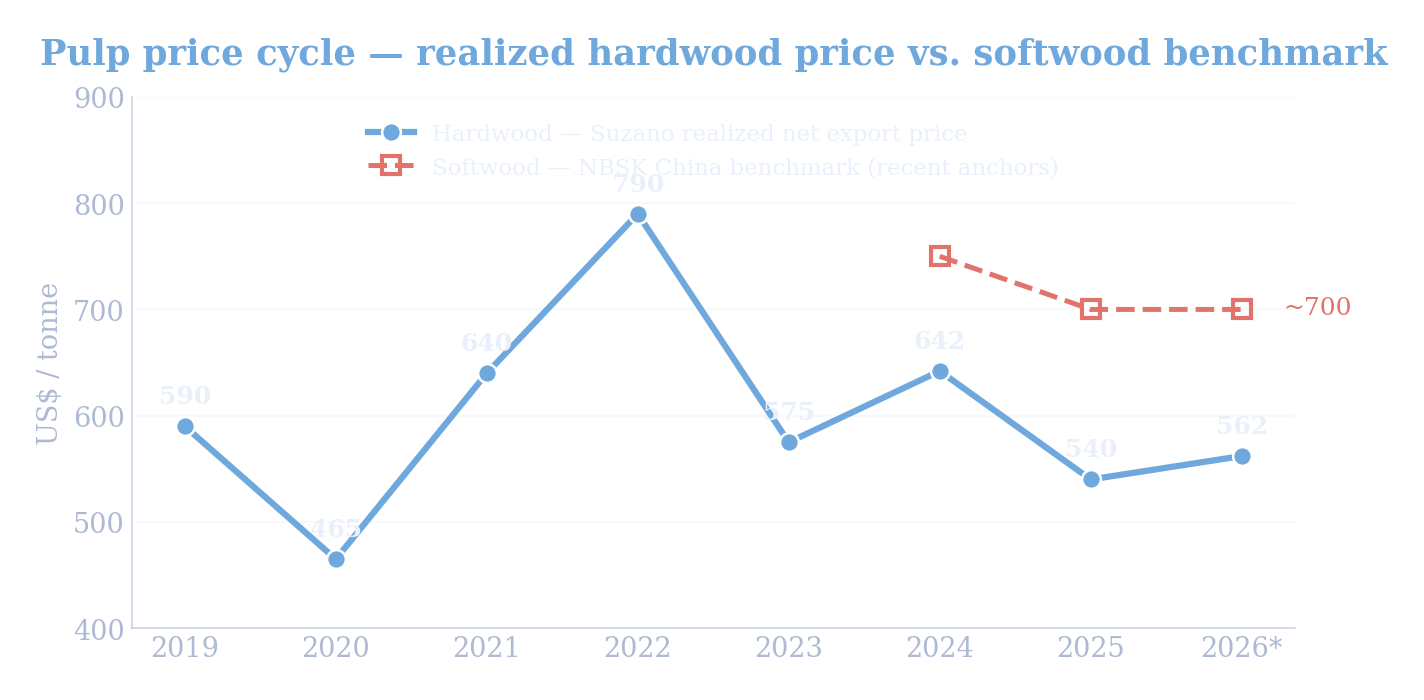 Realised hardwood pulp price vs the softwood (NBSK) benchmark, US$/tonne. Source: Suzano earnings releases; NBSK China benchmark (recent anchors).
A second force sets the rhythm: the Brazilian real.
Suzano earns most of its money in dollars but pays most of its costs in reais, so a weaker real quietly widens margins even when the pulp price does nothing — and a stronger real squeezes them. That is exactly what happened in the first quarter of 2026: the company sold 7% more pulp and dollar prices edged up, yet EBITDA fell 6% because the real strengthened about 10%. Over the last seven years the margin has breathed between 41% at the bottom and 57% at the top — but never near zero, and never close to an operating loss.
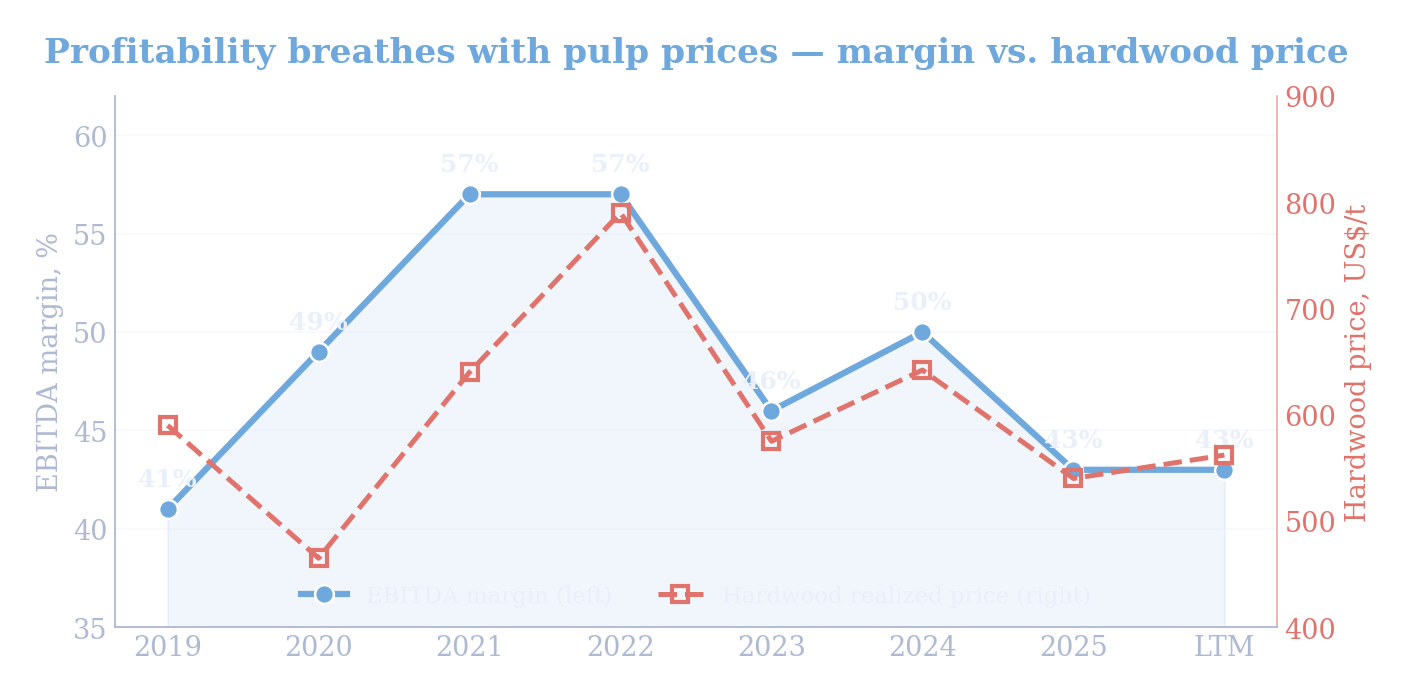 EBITDA margin tracks the hardwood price closely, 41–57% across the cycle. Source: company quarterly series 2019–2026.
The debt is a big number with a comfortable calendar.
Suzano owes US$13.0 billion net of cash — 3.3 times EBITDA, mid-range against its own history of 2.0× (2022) to 4.9× (2019). What makes it comfortable is the cash: US$6.1 billion on hand plus a committed credit line already cover every repayment due through the end of 2028, before counting a single dollar of future profit. The debt has an average life of over six years, a fixed average cost of 5.0% in dollars, and interest is covered 3.6 times by EBITDA.
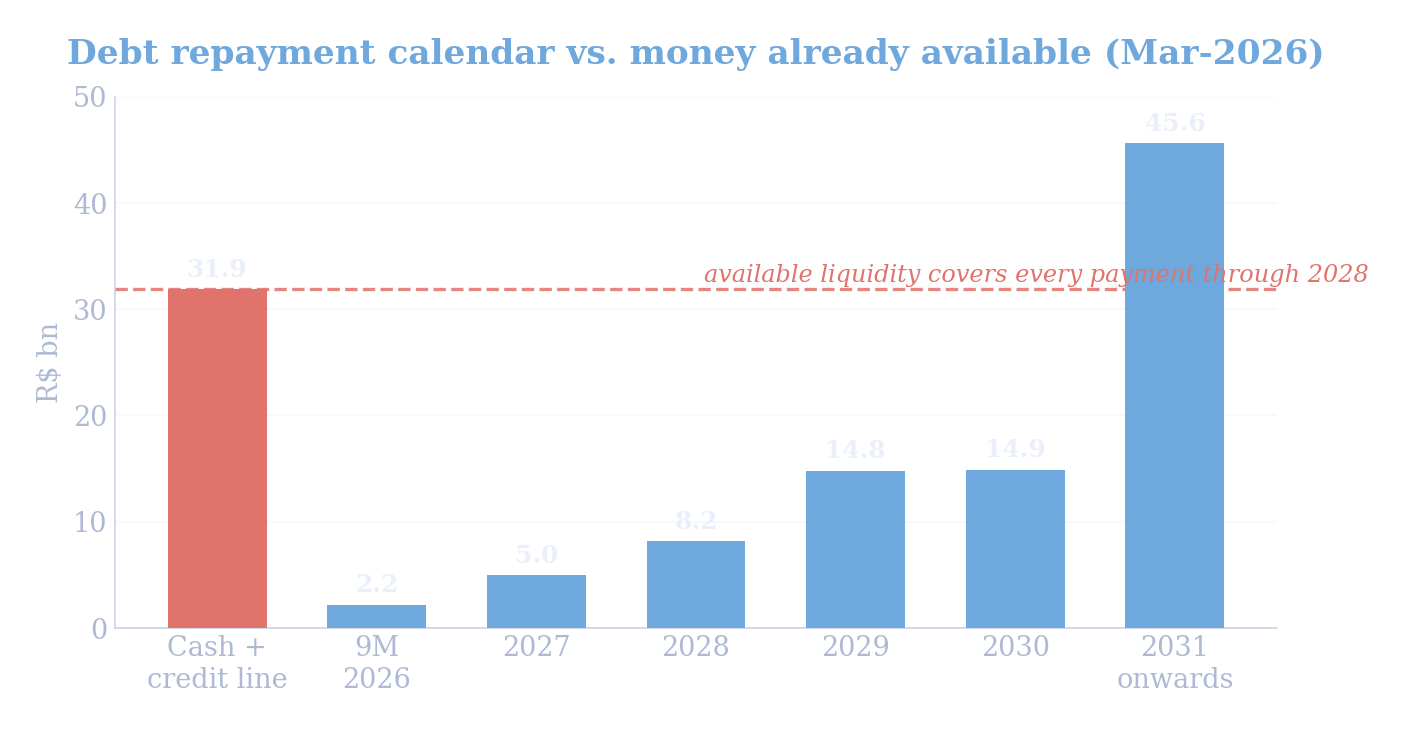 Debt maturities against cash and committed credit already in hand. Source: Suzano 1Q 2026 earnings release.
Two things to watch, stated plainly.
First, protection is light: the bonds carry no financial covenants, so bondholders lean on Suzano's ratings and reputation rather than contractual tripwires. Second, management is in a spending phase — a new CEO (2024) and CFO (2025) have been buying businesses (Kimberly-Clark's tissue operations, US packaging plants, a 15% stake in Austria's Lenzing) and repurchasing shares while leverage is somewhat elevated. Neither is alarming on its own; together they are why our read stays measured rather than enthusiastic.
Against its peers, Suzano is the expensive one — for a reason.
At similar maturities the two Chilean BBB− producers pay about half a point more: Arauco's 2032 yields 6.01% against Suzano's 5.53%. The market is paying up for the largest, lowest-cost producer, the most liquid bonds in the sector, and — alone among its peers — a Positive outlook at all three agencies, the clearest path to a higher rating.
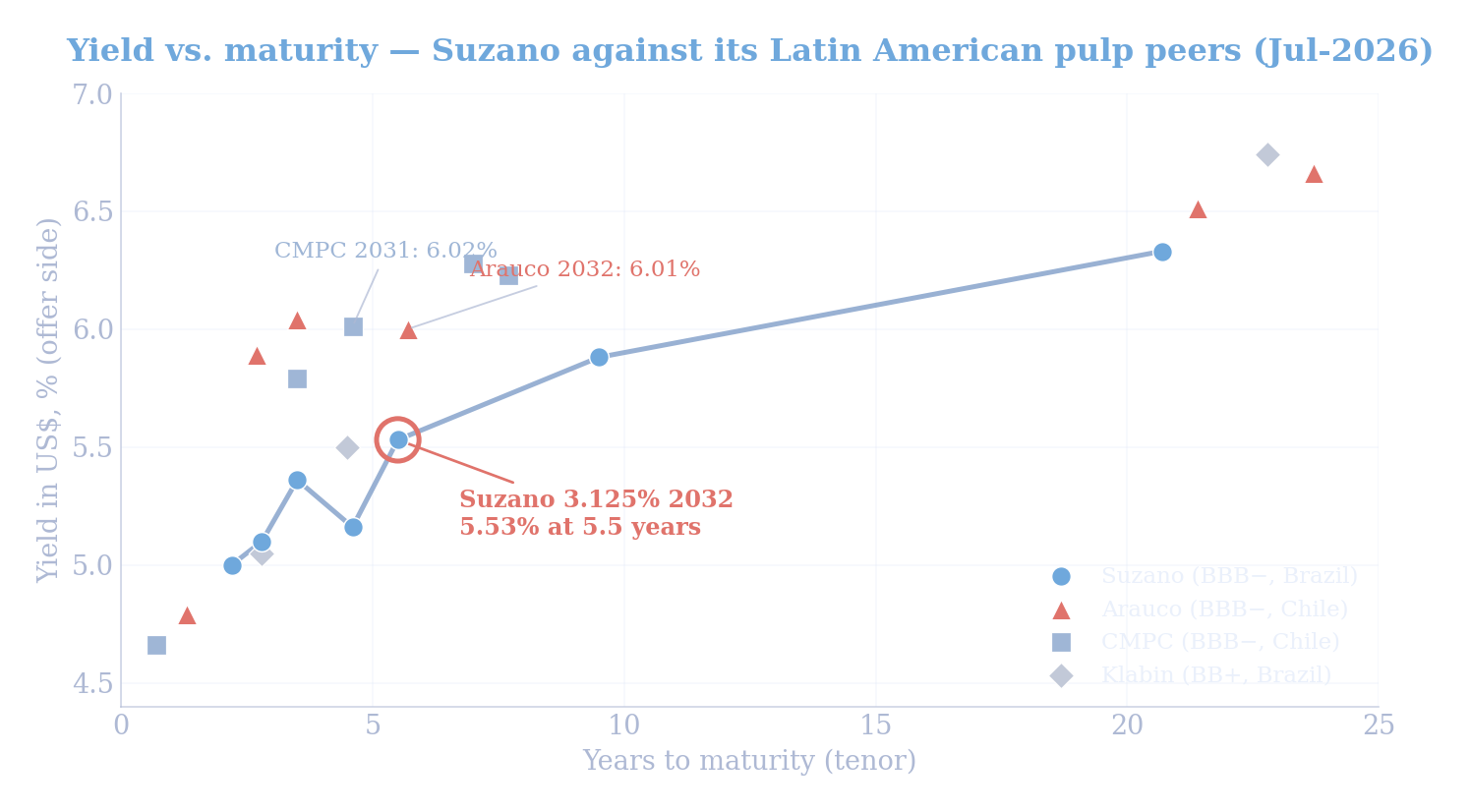 Yield vs maturity: Suzano against Arauco, CMPC and Klabin. Source: Bondfish platform quotes, July 2026.
The Suzano Austria 3.125% notes due January 2032 are senior unsecured obligations, guaranteed by Suzano S.A. US$1.0 billion is outstanding, rated BBB− (Fitch) / BBB− (S&P) / Baa3 (Moody's), all with Positive outlooks. It is a sustainability-linked bond: the coupon stays 3.125% if Suzano meets its end-2026 industrial-water target and steps up to 3.250% if it misses — it cannot fall below 3.125%. (A sister 2031 bond missed its climate target and duly stepped up to 4.00% in June 2026, so the clause is real and enforced.) At a price around 88 the note yields about 5.7% to maturity with a duration of 4.8, meaning a 1-point rise in US yields would move the price about 4.8% the other way.
as of 31-03-2026, USD bn
| Metric | Value | Metric | Value | Metric | Value |
|---|---|---|---|---|---|
| Assets | 31,8 | EBITDA Margin LTM | 43 % | CFO/Debt | 0,17 |
| Revenue LTM | 9,4 | Net debt | 13,0 | FCF LTM | 1,4 |
| EBITDA LTM | 4,0 | Net Debt/EBITDA | 3,3× | Equity | 9,2 |
| Net Profit LTM | 2,2 | EBITDA/Interest | 3,6× | Debt/Equity | 1,9× |
All data and information is provided “as is” for informational purposes only, and is not intended for trading purposes or financial, investment, tax, legal, accounting or other advice. Please consult your broker or financial representative to verify pricing before executing any trade. Bondfish is not an investment adviser, financial adviser or a broker. None of the data and information constitutes investment advice nor an offering, recommendation or solicitation by Bondfish to buy, sell or hold any security or financial product, and Bondfish makes no representation (and has no opinion) regarding the advisability or suitability of any investment. Mention of specific financial products or operations does not constitute an endorsement by Bondfish.
The financial products or operations referred to in such data and information may not be suitable for your investment profile and investment objectives or expectations. It is your responsibility to consider whether any financial product or operation is suitable for you based on your interests, investment objectives, investment horizon and risk appetite. Bondfish shall not be liable for any damages arising from any operations or investments in financial products referred to within. Bondfish does not recommend using the data and information provided as the only basis for making any investment decision.
This data is not updated in real time and represents the prices available at the end of the previous trading day. Bondfish does not verify any data and disclaims any obligation to do so. Bondfish expressly disclaims the accuracy, adequacy, or completeness of any data and shall not be liable for any errors, omissions or other defects therein, delays or interruptions in such data, or for any actions taken in reliance thereon. Bondfish shall not be liable for any damages relating to your use of the information provided herein.
Past performance is not a reliable indicator of future results.