
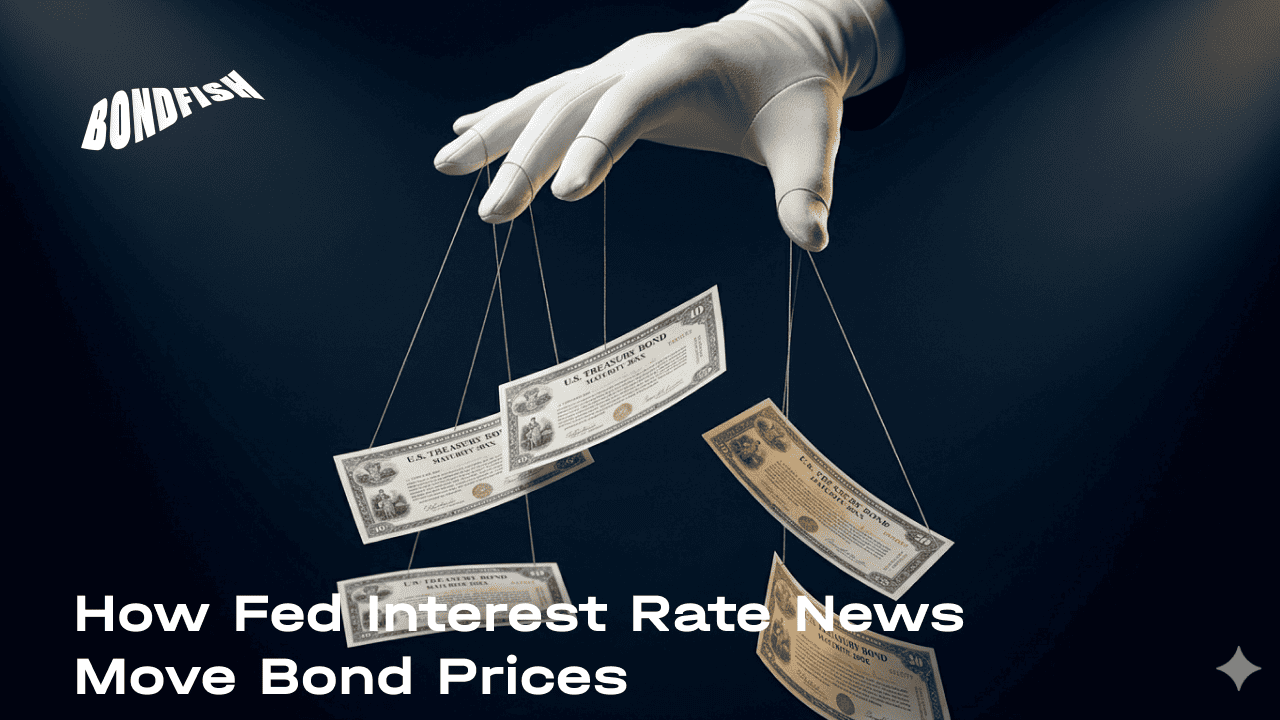
Fed interest rate news matters to bond investors because it changes the expected path of future cash discounting. A bond is a stream of future payments, and the market value of those payments depends heavily on interest rates. When investors expect the federal reserve to keep policy tighter for longer, required yields usually rise and existing bond prices fall. When investors expect the fed to cut rates, required yields often decline and existing bond prices can rise.
The April 29 2026 fed meeting is a useful case study because it showed how quickly the bond market can move when the policy narrative changes. The federal reserve maintained the target range for the federal funds rate at 3,5% to 3,75%, but the statement also made clear that the committee would carefully assess incoming data, the evolving outlook, and the balance of risks before future rate decisions. That language matters because it reduces confidence in a simple easing path and forces investors to reprice bonds across the curve.
The first link between interest rates and bond prices is mechanical. If market yields rise, the fixed coupons on existing bonds become less attractive, so their prices fall. If market yields decline, those same fixed coupons become more attractive, so their prices rise. The longer the maturity and duration, the more sensitive the bond is to interest rate changes.
This is why treasury yields often react immediately to a fed meeting, a press conference, or a new inflation release. The market is not only responding to today’s interest rate decision. It is also updating the average expected federal funds rate over the coming quarters and years. For short-dated bonds, the federal funds rate and expectations for short term interest rates are especially important. For longer-dated bonds, investors also assess inflation expectations, term premium, fiscal risks, growth risks, and other factors.
A simple example shows the logic. A five-year bond with a fixed coupon becomes less valuable if investors suddenly expect the fed to maintain high interest rates for longer. The coupon has not changed, but the opportunity cost of holding that bond has changed. In the same way, if the federal reserve signals that rate cuts are likely, the same bond may rise in price because its fixed coupon looks more valuable relative to the expected rate policy path.
The April 29 2026 meeting came at a moment when the market had already moved away from the idea of easy rate cuts in 2026. Earlier expectations for lower interest rates had been challenged by stronger inflation data, rising energy prices, and a less comfortable economic outlook. By early May, traders had sharply increased the probability of a rate hike during the year, with CME FedWatch data cited by market reports as showing a meaningful rise in the probability of at least one increase.
This matters for bonds because the repricing was not only about one fomc meeting. It was about the whole expected path of the federal funds rate. Financial markets were no longer treating rate cuts as the default scenario. Instead, investors had to consider the possibility that the federal reserve might maintain the current range for longer, or even raise rates if inflation risks continued to rise.
The committee’s statement after April 29 2026 said that recent indicators suggested economic activity had been expanding at a solid pace, while job gains had remained low and the unemployment rate had been little changed in recent months. It also noted a high level of uncertainty about the economic outlook and said the committee remained attentive to the risks to both sides of its dual mandate.
For bond investors, this is a complicated mix. Solid economic activity can support corporate earnings and reduce default risks, which helps credit bonds. But higher inflation and tighter monetary policy can push yields higher, which hurts bond prices, especially for longer-duration securities. This is why a positive growth signal can still be negative for bond prices if it delays rate cuts or creates a risk that the fed may need to raise rates again.
Inflation is central to the bond market reaction because it affects both real returns and central bank behavior. When inflation rises, fixed coupon payments lose purchasing power. Investors then demand higher yields as compensation. At the same time, the federal reserve may need to maintain a more restrictive monetary policy stance to bring inflation back toward its 2% objective.
In recent months, inflation has moved back into the center of the policy debate. Reports after the March data showed the Personal Consumption Expenditures Price Index reaching 3,5% year over year, its highest level in almost three years. That matters because PCE is the inflation measure most closely watched by the federal reserve.
Energy prices have been a major part of the story. The uncertainty about the economic outlook has been heightened by developments in the Middle East, particularly the ongoing Iran war, which has contributed to rising oil prices, higher gasoline prices, and broader inflationary pressure. Higher energy costs can act like a tax on consumers, forcing households to cut spending in other areas, although the full drag on economic growth may appear with a lag.
This creates a difficult setup for monetary policy. If the energy shock lifts inflation but also weakens consumption, the central bank faces risks on both sides. Cutting rates too early may allow inflation expectations to rise. Keeping interest rates high for too long may slow employment and credit activity. That is why the statement’s phrase that the committee will carefully assess incoming data is important. It signals that the fed is not locked into an easing bias.
The federal funds rate is the anchor for the front end of the yield curve. It directly affects overnight money market rates, influences bank funding costs, and shapes expectations for future short-term yields. When the target range for the federal funds rate remains at 3,5% to 3,75%, short-dated bond yields have less room to fall unless investors become confident that rate cuts are coming soon.
As of April 29 2026, the federal reserve maintained that range, and analysts expected the benchmark interest rate to remain near 3,75% by the end of the quarter. Trading Economics also reported that the decision was not unanimous, with one fed governor voting to lower interest rates and three other members objecting to statement language that suggested the central bank would eventually resume cutting rates. It described the 8 to 4 vote as the largest number of dissents since 1992.
For bonds, dissent matters because it changes the perceived distribution of future outcomes. A divided committee makes the path of future rate decisions less predictable. If one fed governor wants a cut, but three other members are uncomfortable with guidance that points toward cuts, the market has to price a wider range of scenarios. That normally increases uncertainty and can raise risk premiums.
The federal open market committee is responsible for open market operations and decisions related to the federal funds market rate. The board of governors separately decides on discount rate changes after recommendations from regional Federal Reserve Banks. In practice, investors focus on the FOMC because its decision-making process determines the appropriate stance of monetary policy, using labor market conditions, inflation pressures, financial developments, and broader market conditions.
When fed expectations shift, the yield curve does not move evenly. The front end usually reacts most directly to changes in the expected federal funds rate. Two-year treasury yields often move sharply when investors revise the probability of rate cuts or a rate hike. Longer maturities respond to the same information, but they also reflect inflation expectations, fiscal supply, risk appetite, and global demand for duration.
A higher-for-longer stance can flatten or invert the curve if short-dated yields rise more than long-dated yields. But if inflation uncertainty rises and investors demand more compensation to hold long-duration bonds, long-dated yields can rise too. In that environment, both short and long bond prices may fall, although the impact is usually larger on bonds with higher duration.
Credit bonds add another layer. Higher interest rates increase refinancing costs and can weaken corporate balance sheets over time. At the same time, if economic activity remains solid, credit spreads may not widen immediately. This is why corporate bond performance depends on both rates and spreads. A strong issuer with a short maturity may remain resilient, while a longer-duration issuer with high leverage may suffer more from rising costs and weaker market liquidity.
The fed can leave interest rates unchanged and still move bond prices significantly. The reason is that investors compare the decision with expectations. If the market expected the fed to sound dovish, but the statement and press conference sound cautious, yields may rise. If the market expected a more aggressive stance, but the fed chair signals patience, yields may fall.
This is why the April 29 2026 communication mattered. The committee maintained the federal funds rate, but the wording pointed to a careful assessment of incoming data, the evolving outlook, and the balance of risks. That kept rate cuts possible, but it also made clear that inflation risks could delay them. In the bond market, that is enough to reprice expected returns.
CME Group’s FedWatch tool is widely used because it translates fed funds futures into implied probabilities for future policy outcomes. The tool itself does not forecast the economy, but it shows where interest rate traders are placing probabilities across future meeting dates.
If financial markets price only a low probability of rate cuts by year-end, bond investors should not assume that lower interest rates will automatically support returns. Instead, they need to evaluate whether current yields already compensate them for duration risk, credit risk, and inflation uncertainty.
Interest rate policy is not the only way the federal reserve affects bonds. Its balance sheet also matters because large-scale holdings of Treasuries and agency mortgage-backed securities influence liquidity, term premium, and market functioning. When the fed reduces its bond holdings, it removes a major source of demand from the market. When it stops reducing those holdings, liquidity conditions may become more stable.
The federal reserve announced in late 2025 that it would end the drawdown of its balance sheet from December 1, 2025, amid signs that money market liquidity was tightening and bank reserve levels were falling. Reuters reported that the decision was intended to keep markets supplied with enough liquidity to maintain interest rate control.
For bond investors, this helps explain why the balance sheet can cushion or amplify rate moves. If the central bank is no longer shrinking its holdings, that may reduce pressure on market liquidity. But it does not eliminate inflation risk, nor does it guarantee lower yields. Bond prices still depend mainly on the expected path of the federal funds rate, inflation, credit quality, and the compensation investors require for duration.
The fed does not directly set mortgage rates, personal loan rates, or credit card APRs, but its policy stance strongly influences them. A sustained high level of interest rates keeps borrowing costs elevated for households and businesses. Reports on May 5, 2026 showed the average U.S. 30-year fixed mortgage rate at 6,46%, with analysts expecting mortgage rates to remain broadly in the 6,0% to 6,5% range through the end of the year.
This matters to bond investors because household borrowing costs feed into consumption, housing activity, bank credit, and securitized products. Mortgage-backed securities, bank bonds, consumer lenders, homebuilders, retailers, and real estate-linked issuers can all be affected by the same policy stance. Higher costs may not immediately create stress, but they can gradually reduce demand and increase credit risks.
There is also a savings channel. High-yield savings accounts and CDs offering around 4% annual yields make cash-like instruments more attractive for some investors. That creates competition for bond funds and shorter-duration fixed income strategies. For bonds to attract demand, investors need enough yield pickup, credit quality, or potential capital gain to justify moving away from cash.
Bond investors should distinguish between political headlines and policy-relevant information. News involving President Trump, a justice department matter, or a criminal investigation may create short-term market noise if it affects confidence, fiscal expectations, or institutional uncertainty. But bond prices usually move more sustainably when those developments change the path of inflation, growth, issuance, or federal reserve policy.
The same applies to headlines about Powell's decision or comments from a fed chair. A single line in a press conference can move yields if investors believe it changes the reaction function of the committee. But the market ultimately tests words against data. If inflation remains high, employment weakens, or energy prices rise further, the committee may need to adjust its appropriate stance regardless of political pressure or media interpretation.
This is why professional bond analysis should not reduce fed news to a simple “good” or “bad” headline. A hold can be hawkish if rate cuts are delayed. A dovish comment can fail to rally bonds if inflation data remain uncomfortable. A rate hike can hurt duration but sometimes support credit confidence if it protects long-run inflation credibility.
The current environment supports a focus on portfolio resilience. A moderately restrictive monetary policy stance, persistent inflation uncertainty, and a divided committee all argue against relying on one simple rate view. Investors should assess duration, credit quality, call risk, liquidity, and currency exposure together.
Three practical fixed-income questions are especially important now:
How much duration risk is the portfolio taking if treasury yields rise again?
Is the yield high enough to compensate for credit risks and refinancing pressure?
Does the issuer have enough liquidity and pricing power to handle higher costs?
The answers differ across government bonds, investment-grade corporates, high-yield bonds, inflation-linked bonds, floating-rate notes, and short-maturity instruments. Lower interest rates would support many bond prices, but a delayed easing cycle or renewed rate hike risk would favor shorter duration and stronger balance sheets. Investors should expect market volatility to remain elevated while inflation, energy prices, and labor market data continue contributing to uncertainty.
Fed news moves bond prices because it changes the discount rate applied to future cash flows. But the practical challenge for investors is not only understanding the direction of interest rates. It is finding individual bonds where yield, maturity, issuer quality, broker availability, and risk profile make sense together.
Bondfish helps address this problem by making bond investing more transparent and easier to analyze. Investors can use the Bondfish bond screener to compare available bonds by yield, maturity, currency, credit risk, and other key parameters. The platform’s issuer overviews and bond-focused analysis help users understand whether a bond’s return potential is driven by duration, credit spread, issuer fundamentals, or market dislocation.
In an environment where the fed may keep the federal funds rate high, rate cuts are uncertain, inflation remains above target, and energy-driven risks could still emerge, bond selection becomes more important than simply buying exposure to the market. Bondfish is designed for that exact task: helping investors move from broad interest rate headlines to specific, analyzable bond opportunities.