
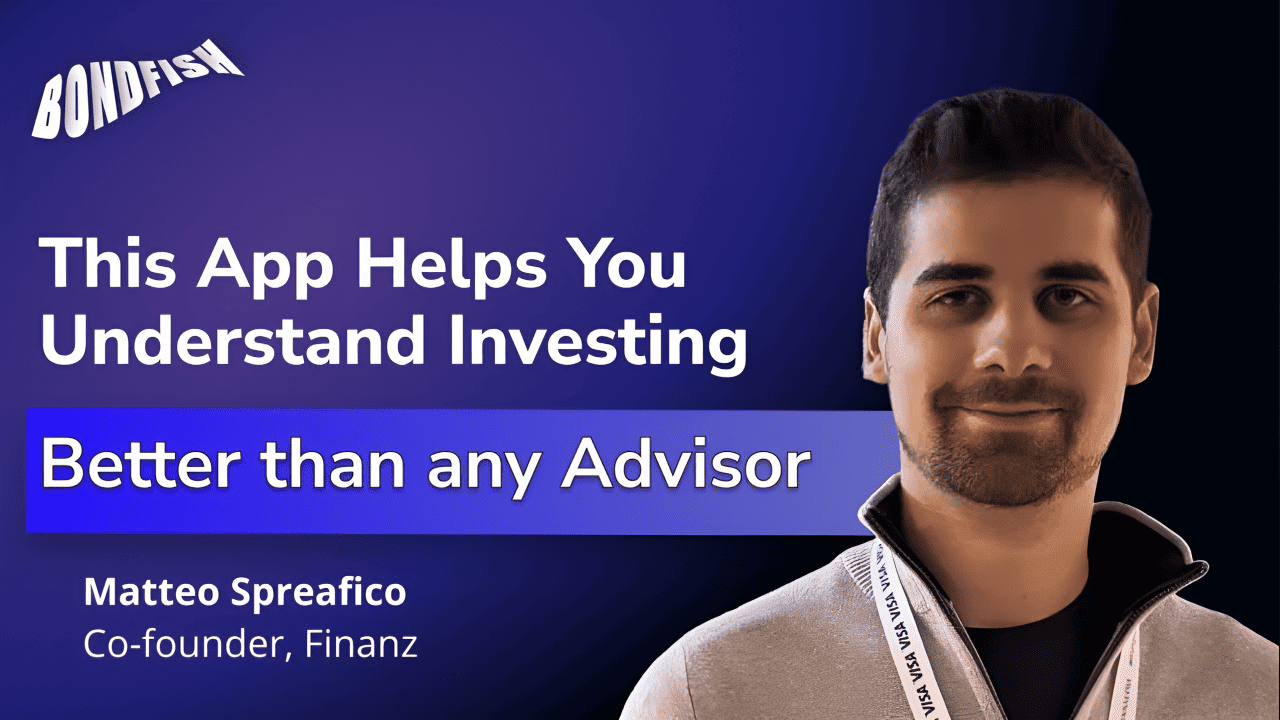
What would it take to bring financial education to a generation of young Europeans who have never been taught how to invest? In this episode of the Bondfish Human Finance Podcast, host Anatoly Shkareda, Chief Marketing Officer at Bondfish, sits down with Matteo Spreafico, co-founder of FinanZ, the Italian fintech startup that has built what its founders describe as a Duolingo for investing. The conversation covers how FinanZ reached 50,000 users within its first year, why low financial literacy is not merely a personal problem but a structural challenge for the European economy, and how the team plans to expand its habit-forming learning platform across the continent.
The Concept
The founding insight behind FinanZ emerged during the COVID-19 pandemic, when a wave of public interest in personal finance exposed a persistent gap: there was no shortage of information online, but almost none of it was tailored to where an individual actually stood financially. Matteo Spreafico and his three co-founders, all under the age of 25 at the time, recognised that the problem was not the absence of content but the absence of personalisation.
The solution they arrived at was deliberate in its simplicity. Rather than building a new category from scratch, the team looked to the most successful educational platform in the world and asked whether its mechanics could be applied to financial literacy. Duolingo had achieved something remarkable: it made language learning a daily habit through short lessons, gamified progression, and a format that felt immediately familiar to smartphone users regardless of age or background. FinanZ set out to replicate that architecture, substituting investment concepts for vocabulary.
“We didn't reinvent anything. We took what was the most successful educational platform on the global stage and rebuilt it for another sector, another need, which was financial education.
— Matteo Spreafico, Co-founder, FinanZ
The primary audience FinanZ targets is young workers between 18 and 35 who are earning their first meaningful income and confronting, often for the first time, the question of what to do with their savings. Spreafico noted that this cohort is aware that investing matters, regularly encounters the concept through social media and peers, but lacks the foundational knowledge to act with confidence. The app positions itself not as a course to complete but as a routine to maintain, designed to lower the threshold for beginning rather than raising the bar for mastery.
Growth
Launched in November of the previous year, FinanZ passed 50,000 registered users within its first twelve months of operation, a pace that Shkareda described as exceptional for a fintech product at the pre-seed stage. Spreafico attributed the trajectory to two principles that have shaped the team's culture since founding. The first is what he called obsession: a daily, deliberate focus on how the product can be made better and how it can improve the lives of its users. The second is unusually intensive direct contact with customers.
Despite having crossed the 50,000-user milestone, the FinanZ team continues to conduct approximately five 30-minute calls with active users every single day. The purpose is not support but learning: understanding precisely where the product is falling short and where improvements would have the greatest impact. Spreafico argued that founders, particularly early on, systematically underestimate the value of open conversation and overestimate the risk of sharing their ideas. In his view, the probability that a potential investor, competitor, or partner would steal an unpolished concept is vanishingly small compared to the probability that they would offer useful feedback, connections, or perspective.
“Talk with your competitors, talk with your customers, talk with investors, talk with possible partners. People are really focused on their own work — it is far more likely they will help you than steal from you.
— Matteo Spreafico, Co-founder, FinanZ
Market Context
A significant portion of the episode was devoted to situating FinanZ's mission within a broader macroeconomic reality. Spreafico and Shkareda noted that more than 335 million Europeans, representing over 75% of the continent's population, do not invest. The consequence is visible in aggregate data: in excess of 10 trillion euros sits in European bank accounts, generating little or no real return for its owners while inflation steadily erodes purchasing power.
Spreafico argued that this is not simply a missed opportunity for individual savers but a structural drag on Europe's capacity for economic growth. At a time when public debate is dominated by large-scale investment agendas, from rearmament to green transition to next-generation infrastructure, the European Union's ability to mobilise private capital alongside public funding is constrained by a population that lacks the knowledge and confidence to participate. The countries that have historically invested the most in financial education, he observed, tend to show meaningfully higher rates of private investment participation.
The conversation also addressed Italian investor behaviour specifically. Spreafico noted that Italian savers have traditionally shown a strong preference for bonds, including Italian government bonds known as BTPs, which benefit from a preferential tax rate of 12.5%. He suggested this conservatism is a direct reflection of limited financial education: people are unlikely to invest in instruments or asset classes they do not understand, and the result is a population concentrated in the most familiar and perceived-to-be-safe products, often at the expense of long-term wealth creation.
Both host and guest also discussed the sustainability of European pension systems, noting that ageing demographics and accumulating public debt are placing mounting pressure on state-funded retirement models. Spreafico framed the issue as one that demands honest political conversation: whether governments intend to prioritise the financial security of current retirees or the longer-term interests of younger generations is a question that, in his view, is being avoided rather than answered. The implication for individuals, he suggested, is that building personal investment knowledge and a private savings habit is no longer optional but structurally necessary.
Practical Application
The discussion turned to the role artificial intelligence plays within the FinanZ platform. Spreafico was careful to distinguish between AI as a substitute for learning and AI as an enabler of it. The company's approach uses AI to personalise and adapt the educational experience in real time, tracking how each user interacts with individual lessons and adjusting content accordingly. Where a user struggles with a concept, the platform can surface an alternative explanation generated by AI. A forthcoming feature called Smart Tips is intended to extend this further, offering users a comprehensive overview of their financial situation based on their income, savings, and goals, and then recommending concrete next steps.
Spreafico was emphatic, however, that AI should not remove the requirement to understand what one is doing. The risk of delegating financial decisions to an automated system without the underlying literacy to interpret its outputs, he argued, is that errors get attributed to the tool rather than to the absence of knowledge that made the error possible in the first place. FinanZ's philosophy positions AI as a layer that accelerates and personalises learning, not one that replaces it.
On geographic expansion, Spreafico confirmed that Spain will be FinanZ's first market outside Italy, chosen for its cultural and linguistic proximity. From there, the plan is to move through Portugal and the western part of Europe before addressing central and eastern markets. He noted that the team will approach each new market with the same iterative discipline that drove growth in Italy: test quickly, gather feedback, improve, and then scale what works.
Borrow from proven formats. Rather than inventing a new category of product, FinanZ identified the best-performing educational platform in an adjacent domain and adapted its core mechanics to financial literacy. The format's familiarity reduces onboarding friction significantly.
Maintain high-frequency customer contact at every stage of growth. Even at 50,000 users, the FinanZ team runs five dedicated user calls per day. Direct conversation with real users generates faster and more actionable insight than any analytics dashboard.
Talk to everyone, protect little. The risk that someone steals an early-stage idea is far smaller than the value created by openly testing it with investors, competitors, partners, and potential customers. Feedback at the idea stage is worth more than secrecy.
Use AI to personalise, not to decide. AI is most effective in financial education when it tailors the learning experience to an individual's pace and gaps. Deploying it as a substitute for knowledge creation, rather than as a catalyst for it, undermines the user's long-term financial capability.
Expand incrementally into culturally proximate markets first. FinanZ's choice of Spain as its first international market reflects a deliberate sequencing strategy. Cultural and linguistic similarity reduces the cost of learning how to localise, before tackling more distant markets.
Key Takeaways