Building a TIPS Ladder for Inflation-Proof Retirement Income

A TIPS ladder builds inflation-proof retirement income by holding Treasury Inflation-Protected Securities that mature one year at a time, each one locking in a return set above inflation. As of September 2026, a 30-year TIPS ladder locks in roughly 2.9% a year above inflation, close to the most it has offered in more than two decades.
For most of the 2010s, laddering inflation-protected bonds was a thankless exercise. Real yields were thin, and for a stretch of 2020 and 2021 they were negative, meaning a saver was guaranteed to lose purchasing power in exchange for the safety. That has flipped. Real yields have reset to their highest sustained level since before the 2008 financial crisis, and retirees are rediscovering a strategy that does something no stock portfolio can promise: a fixed, inflation-adjusted paycheck for decades, with the U.S. Treasury on the other side of the trade.
What a TIPS ladder gives a retirement income plan
A TIPS ladder is a set of Treasury Inflation-Protected Securities bought so that one bond matures each year, for as many years as you want income. Each year, the maturing rung hands you back its inflation-adjusted principal, which you spend, while the rest of the ladder keeps compounding at its locked-in real yield (the return above inflation).
For retirement income specifically, that structure solves problems a stock-heavy portfolio cannot:
- Known real cash flows. You match each year of spending to a bond that will be worth a known amount in today's purchasing power, whatever inflation does.
- No sequence-of-returns risk. Because you hold each rung to maturity, a bad year in markets does not force you to sell at a loss to eat.
- No guessing. The real return is contractual the day you buy, so there is no market timing and no reinvestment gamble until a rung matures.
The trade-off is that a ladder is a spending tool, not a growth engine. It is best used for the essential, must-pay portion of a retirement budget, with stocks left to do the growing elsewhere.
How TIPS protect your income from inflation
A conventional Treasury pays a fixed number of dollars; inflation quietly eats their value. A TIPS is built to prevent exactly that. Its principal is adjusted every day in line with the Consumer Price Index (CPI-U), so the amount you are owed rises with the cost of living. The fixed coupon rate is then paid on that inflation-adjusted principal, which means the interest payments grow with inflation too.
Two features matter for a retiree relying on the income:
- A deflation floor. If prices fall over the bond's life, you still get back at least your original face value at maturity, never less.
- A real, not nominal, promise. Held to maturity, a TIPS delivers its stated real yield on top of whatever inflation turns out to be, which is the whole point for income that has to last.
This is also why TIPS behave so differently from ordinary bonds when the cost of living jumps. If you want the fuller picture, see our explainer on how inflation affects bond prices.
Why a TIPS ladder looks compelling right now
The reason this strategy is back in fashion is simple: real yields are positive again. To show it, we priced a fresh 30-year TIPS ladder at the end of every month back to 2004, using the Treasury real-yield curve, and tracked the single real return the ladder locks in. The line below is that history.
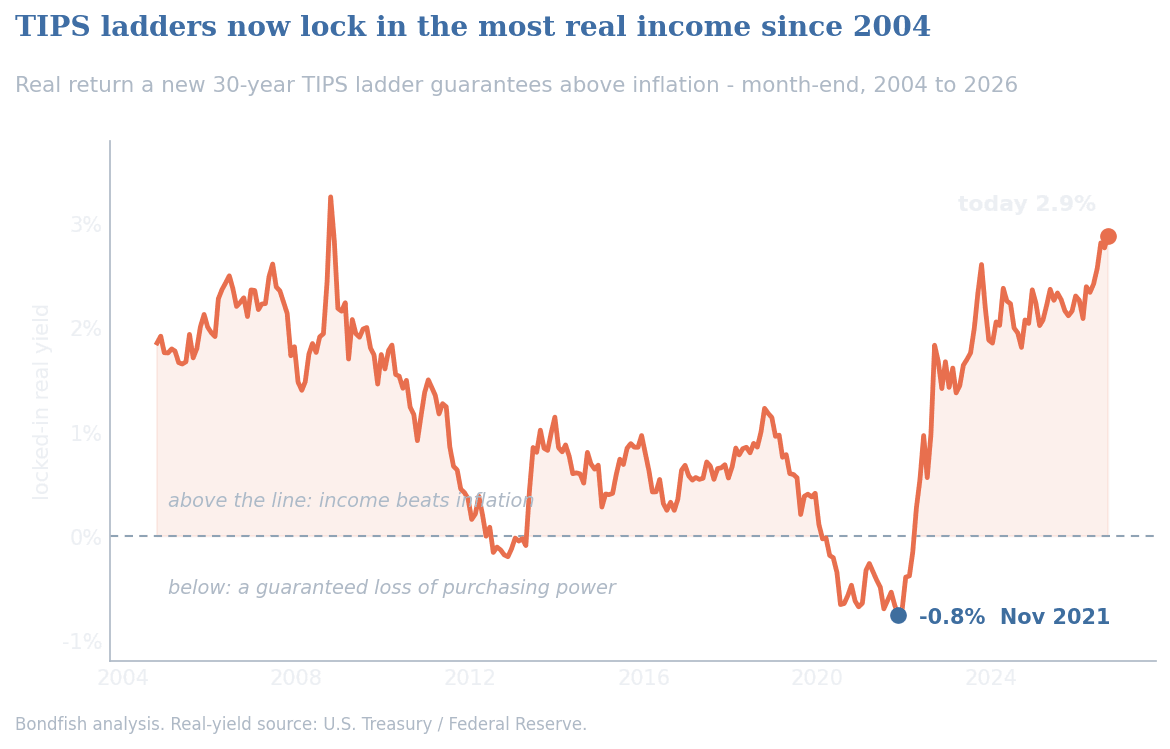 The real return a new 30-year TIPS ladder guarantees above inflation, month-end 2004 to 2026. Source: U.S. Treasury and Federal Reserve real-yield data; Bondfish analysis.
Today a 30-year ladder locks in about 2.9% a year above inflation. That is more than double its 22-year average of roughly 1.2%, and apart from a brief spike during the 2008 crisis it is the most a ladder has offered in the whole period. Contrast that with November 2021, when the same ladder locked in minus 0.76%: buyers back then were paying the Treasury for the privilege of losing ground to inflation, slowly but with certainty.
Positive real yields do not just improve the return; they slash the price of the income. The chart below shows the one-time cost of funding $50,000 a year of inflation-adjusted income for 30 years, then versus now.
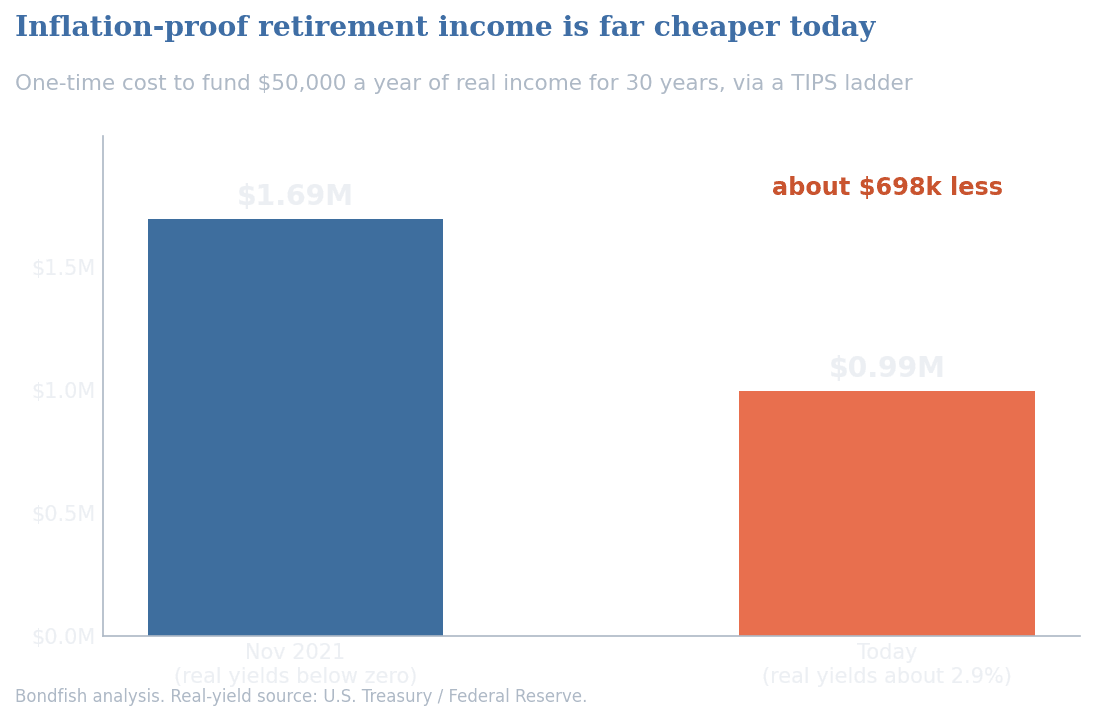 One-time cost to fund $50,000 a year of real income for 30 years via a TIPS ladder. Source: U.S. Treasury and Federal Reserve real-yield data; Bondfish analysis.
The same inflation-proof paycheck that cost about $1.69 million at the 2021 lows costs roughly $994,000 today, a saving of nearly $700,000. When real yields are high, guaranteed real income is on sale.
What a 30-year TIPS ladder locks in today
A ladder does not earn one flat yield; each rung earns the real yield for its own maturity. The whole real curve has swung from negative in 2021 to firmly positive now, and it slopes upward, so longer rungs pay you more.
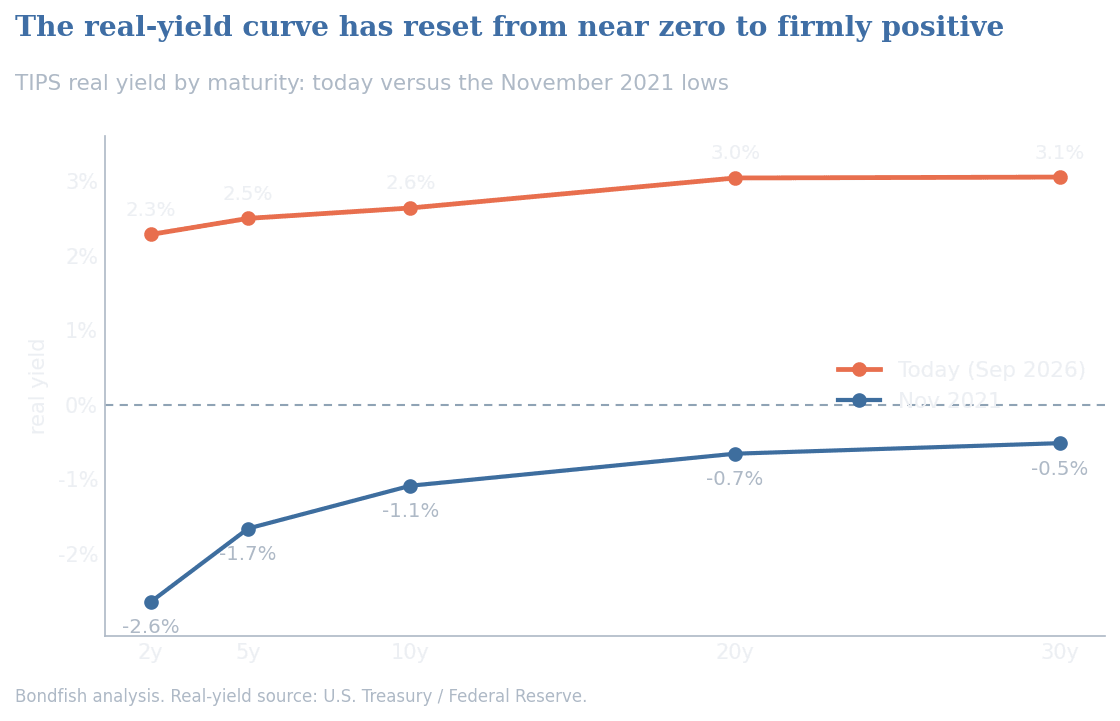 TIPS real yield by maturity, today versus the November 2021 lows. Source: U.S. Treasury and Federal Reserve real-yield data; Bondfish analysis.
Across a full 30-year ladder built today, the rungs look roughly like this:
| Rung (maturity) | Approx. real yield today |
|---|---|
| 2028 | about 2.3% |
| 2031 | about 2.5% |
| 2035 | about 2.6% |
| 2040 | about 2.8% |
| 2045 | about 3.0% |
| 2050 | about 3.1% |
| 2055 | about 3.1% |
One quirk to plan around: there are no TIPS maturing in 2037, 2038 or 2039. The Treasury simply did not issue bonds that land in those years, so a continuous ladder has three empty rungs in the mid-2030s that you fill by other means (covered below).
How to build a TIPS ladder, step by step
- Fix the horizon and the annual amount. Decide how many years of income you want to cover (30 is common) and how much real spending you want each year, for example $50,000 in today's dollars.
- Size each rung to that spending. For each year, buy enough TIPS so the maturing principal, plus that year's coupons, delivers your target amount in real terms.
- Buy one maturity per year. Work from the nearest maturity out to your target year, so exactly one rung comes due every year. You can compare issues and yields across the wider market with the Bondfish bond screener before you buy the specific Treasuries.
- Bridge the gap years. To cover 2037 to 2039, buy extra of the nearest available rungs (2036 and 2040) and set aside the right amount, a standard workaround among ladder builders.
- Hold every rung to maturity. The locked-in real yield only holds if you do not sell early. Selling before maturity exposes you to price swings, so the ladder is a hold-to-maturity plan by design. Our guide to plan a bond ladder's maturities walks through the mechanics.
- Decide individual bonds versus a fund. You can buy individual TIPS at auction through TreasuryDirect or on the secondary market through a brokerage. Defined-maturity TIPS funds can approximate a ladder with less hands-on work, at the cost of some precision.
The trade-offs to weigh
- It ends. A 30-year ladder stops paying in year 31. If you may live longer, pair it with Social Security or an annuity for the tail, or build in extra years.
- Taxes on phantom income. The yearly inflation adjustment to principal is taxable in the year it happens, even though you do not receive it until maturity. For that reason, TIPS ladders usually belong in a tax-advantaged account such as an IRA.
- Opportunity cost. Real yields could rise further after you buy, leaving later buyers a better deal. You give up that upside in exchange for certainty, but you still lock in a positive real return today.
- Interim price risk. If you must sell a rung early, its price moves with real rates and duration; only holding to maturity guarantees the outcome.
A TIPS ladder is not built to make you rich. It is built so that inflation can never make you poor.
The Bottom Line
Today's positive real yields make a TIPS ladder one of the few ways to buy a guaranteed, inflation-adjusted retirement paycheck, and it is far cheaper than it was three years ago. At about 2.9% real, a 30-year ladder locks in income that keeps pace with inflation for decades. It will not grow wealth like stocks, but it can take the guesswork out of the essential-spending part of a retirement plan.
Sources & Further Reading
Data and methodology
- U.S. Treasury (TreasuryDirect): Treasury Inflation-Protected Securities
- U.S. Bureau of Labor Statistics: Consumer Price Index (CPI)
- Real-yield levels reflect U.S. Treasury and Federal Reserve data; ladder returns and costs are Bondfish's own calculation.
How TIPS and TIPS ladders work
- Bogleheads: Treasury Inflation-Protected Security
- Morningstar: Retirees, Take the Risk Out of Your Income With a TIPS Ladder
- Retirement Researcher: How to Build a TIPS Bond Ladder for Retirement Income
This article is for general information only and is not investment advice. Bond investing involves risk, including possible loss of principal. Consider your own circumstances or consult a licensed financial professional before investing.
This article does not constitute investment advice or personal recommendation. Investments in securities and other financial instruments always involve the risk of loss of your capital. Past performance is not a reliable indicator of future results. Bondfish does not recommend using the data and information provided as the only basis for making any investment decision. You should not make any investment decisions without first conducting your own research and considering your own financial situation.