Weekly bond digest: October 12 – October 18, 2026
Yield Curves
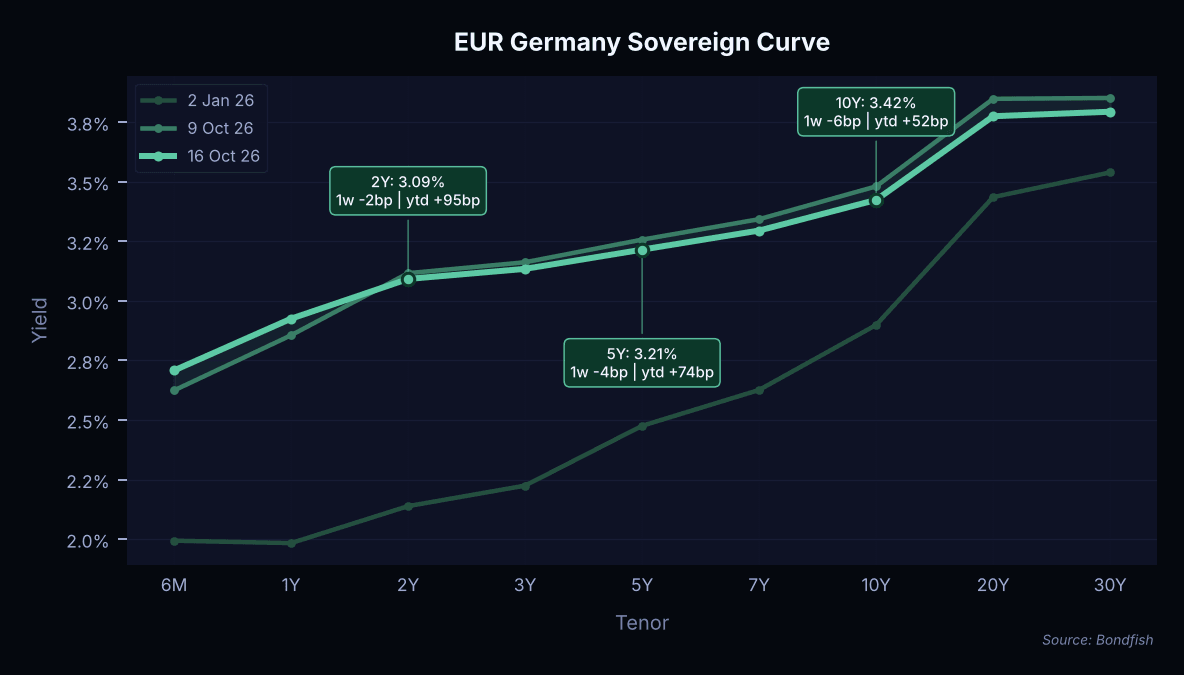
German government bonds edged higher this week, so yields fell slightly. The 10-year yield dropped 6 basis points to 3.42%, and the 2-year slipped 2 basis points to 3.09%. Worries about AI stocks drove the moves, not energy: gas prices hit new highs, yet euro yields barely reacted. The gap between Italian and German 10-year yields narrowed from 109 to 106 basis points, as concerns about the euro area's more indebted governments kept easing. Investors now look ahead to Moody's review of France's rating on October 23 and to new business surveys next week.
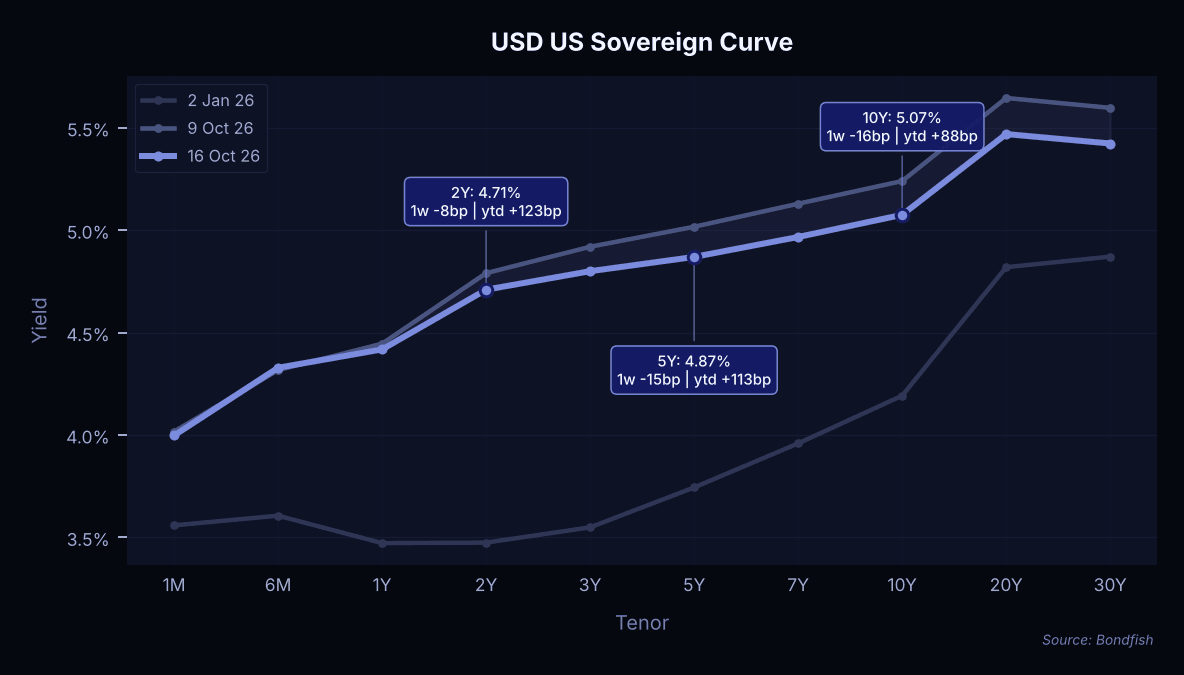
US Treasuries rallied, and long-term bonds gained the most. The 10-year yield fell from 5.24% to 5.07%, the 30-year dropped 17 basis points to 5.42%, and the 2-year fell 8 basis points to 4.71%. Yields rose on Wednesday after a strong inflation report, then reversed as a sell-off in AI-related stocks spread from South Korea to the Nasdaq. Fed Governor Michelle Bowman said she felt no urgency to raise rates again, and Chair Kevin Warsh said the economy had behaved broadly as the Fed expected, which ended bets on a rate rise in October. Long-term yields also fell on speculation that the Treasury might sell fewer long-term bonds; it announces its next borrowing plans on November 4.
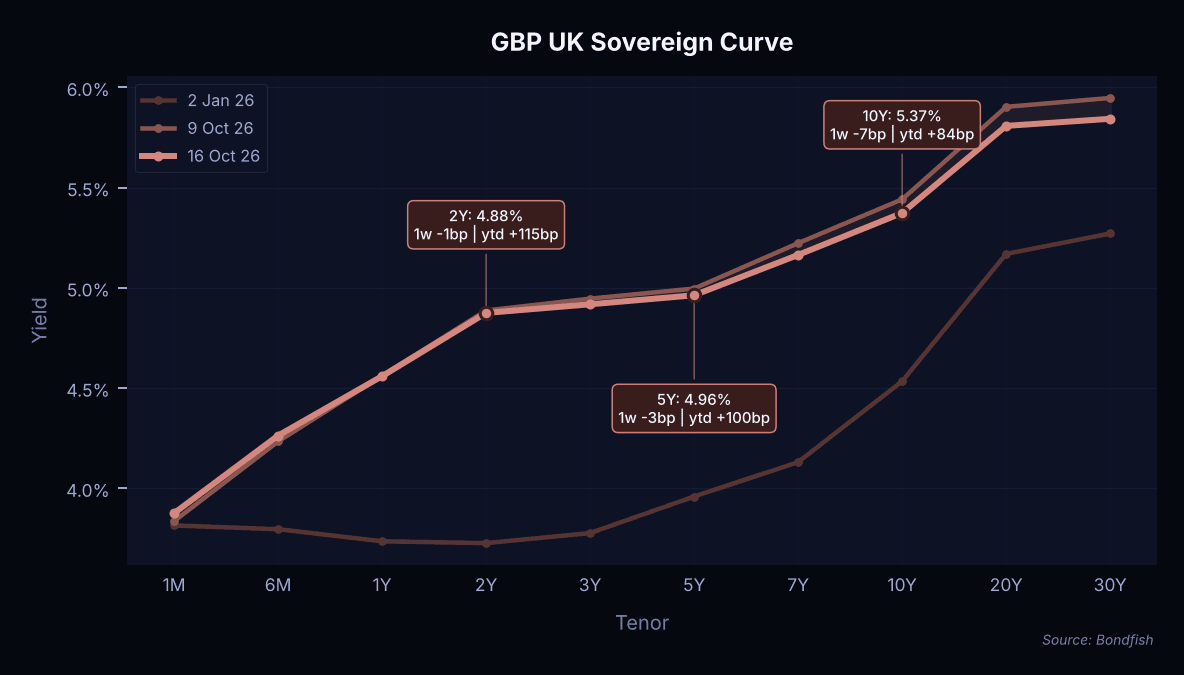
UK gilts gained too, though less than Treasuries. The 10-year yield fell 7 basis points to 5.37%, and the 30-year fell 10 basis points to 5.84%, while the 2-year barely moved at 4.88%. Short-term yields stayed high because markets still expect the Bank of England to raise rates, with a hike in November almost fully priced in. The Bank's Chief Economist Huw Pill pushed back this week, saying he doubted that four rate rises would be needed over the next year. Next week brings September inflation figures, and Chancellor John Healey presents his budget on October 28.
For long-term investors, today's government bond yields look attractive. Over the past 25 years, when yields started near current levels, government bonds maturing in 5 to 10 years made money over the following 12 months every time in the US and the UK, and in 74% to 100% of cases in the euro area.
Top gainers
Long-dated US bonds led the gains as Treasury yields fell. When yields drop, bonds with the longest maturities rise the most. Howard University's 2051 bond gained the most, up 3.4%, and MIT's 100-year bonds due in 2111 and 2114 rose 3.4% and 3.2%. The 2052 bond of ratings firm Moody's added 3.3%, and drinks maker Keurig Dr Pepper's 2048 bond rose 3.2%.
| Name | Cur | Price change 1w (%) |
Yield | Risk Level |
|---|---|---|---|---|
| Howard Uni 4.756% Oct 2051 | USD | 3,40% | 7,16% | |
| MIT USA 5.6% Jul 2111 | USD | 3,35% | 6,15% | |
| Moody's 3.75% Feb 2052 | USD | 3,30% | 6,20% | |
| Keurig Dr Pepper 5.085% May 2048 | USD | 3,21% | 6,50% | |
| MIT USA 4.678% Jul 2114 | USD | 3,16% | 6,14% | |
| Archer Daniels 6.95% Dec 2097 | USD | 3,05% | 6,34% | |
| Kyndryl Holdings 4.1% Oct 2041 | USD | 3,00% | 7,65% | |
| Microsoft 4.75% Nov 2055 | USD | 2,99% | 5,98% | |
| Public SVC E&G 4.15% Nov 2045 | USD | 2,90% | 6,22% | |
| Norfolk Southern 5.1% Aug 2118 | USD | 2,90% | 6,22% |
Top losers
Riskier bonds fell as US junk bond yields climbed to their highest level in 18 months. AI cloud company CoreWeave's 2030 bond dropped 6.2% after its co-founder said it was looking at borrowing in the investment-grade market, which made investors fear much more debt. Paramount Global's 2031 bond lost 3.7%, as investors worried about the debt Paramount Skydance took on to buy Warner Bros. Discovery. Glass maker Owens-Brockway's 2032 bond, home appliance maker Whirlpool's 2033 bond and tyre maker Goodyear's 2031 bond each lost between 2.1% and 2.4%.
| Name | Cur | Price change 1w (%) |
Yield | Risk Level |
|---|---|---|---|---|
| CoreWeave 9.25% Jun 2030 | USD | -6,23% | 14,21% | |
| Paramount Global 4.95% Jan 2031 | USD | -3,71% | 10,78% | |
| Owens Brockway 7.375% Jun 2032 | USD | -2,44% | 11,18% | |
| Whirlpool 5.5% Mar 2033 | USD | -2,33% | 12,97% | |
| Goodyear 5.25% Jul 2031 | USD | -2,13% | 10,60% | |
| GLP Pte 9.75% May 2028 | USD | -2,06% | 20,87% | |
| Goodyear 5.25% Apr 2031 | USD | -2,03% | 10,53% | |
| Oracle 5.95% Sep 2055 | USD | -1,83% | 8,50% | |
| MHP Lux 6.25% Sep 2029 | USD | -1,83% | 12,27% | |
| Oracle 6.5% Apr 2038 | USD | -1,67% | 7,81% |
Rating changes
Note: only long-term senior unsecured ratings were taken into account.
Upgrades outnumbered downgrades this week, 20 to 16. S&P raised memory-chip maker Sandisk two notches to BBB and wire maker Southwire to BBB-, so both now have investment-grade ratings. Moody's lifted Egypt to B3 from Caa1. On the downside, S&P cut Warner Bros. Discovery to BB, a notch deeper into junk, after its takeover by Paramount Skydance added a large amount of debt. Fitch cut paper maker Domtar three notches to CCC+.
| Issuer | Agency | Change |
|---|---|---|
| 1440 Foods Topco | S&P | CCC+ → CCC |
| A2Dominion Housing | Fitch | A → A- |
| Allstate | Fitch | |
| Almaviva Developpement | S&P | B → B- |
| Arab Republic of Egypt | Moody's | Caa1 → B3 |
| Botswana Development Corporation | Moody's | Baa3 → Ba1 |
| Bread Financial | Moody's | Ba2 → Ba1 |
| Clear Channel Outdoor | S&P | CCC+ → B+ |
| Cogent Communications | S&P | B- → CCC+ |
| Corus Entertainment | S&P | D → CCC |
| Dechra Topco | Fitch | B+ → B |
| DISH DBS | S&P | D → CCC+ |
| Domtar | Fitch | B+ → CCC+ |
| Falabella | Fitch | BBB- → BBB |
| GEO Group | S&P | BB- → BB |
| Grant Thornton Advisors | S&P | B → B+ |
| Hyde Housing Association | Fitch | A → A- |
| Kallpa Generacion | Fitch | BBB- → BBB |
| Kier Group | Fitch | BB+ → BBB- |
| Kioxia | S&P | BBB- → BBB |
| New Oriental Education | Moody's | Baa3 → Baa2 |
| Nitrogenmuvek | S&P | CCC+ → B- |
| Nordea Bank | Moody's | Aa2 → Aa3 |
| Polygon | S&P | B → CCC+ |
| Rekeep | S&P | B → B- |
| Republic of Cameroon | Fitch | B → B- |
| Russell Investments | S&P | BB- (new) |
| Sabert | S&P | B+ → B |
| Sandisk | S&P | BB+ → BBB |
| SLB | S&P | A → A+ |
| SouthState Bank | Moody's | Baa3 → Baa2 |
| Southwire | S&P | BB+ → BBB- |
| SWF Holdings I | S&P | CCC+ → CCC |
| Unite Group | S&P | BBB+ → BBB |
| Vector | S&P | BBB+ → A- |
| Warner Bros. Discovery | S&P | BB+ → BB |
New issues
New bond sales slowed as many companies stayed away ahead of their quarterly results and markets swung. Euro-area investment-grade sales totalled about €5 billion, leaving October on track to be the slowest since 2023, and only three US junk bond deals priced, worth $2 billion in total. Banks borrowed easily after their results: JPMorgan Chase sold bonds in three parts at yields of up to 6.1%, and Bank of Nova Scotia raised $2.3 billion in four parts, with fixed yields of 5.4% to 5.9%. Hospital operator Select Medical paid 7.6% on an 8-year bond. In euros, the European Union sold €10 billion of 7- and 15-year bonds at 3.8% to 4.4%, and Luxembourg borrowed €1.7 billion for 10 years at 3.7%.
| Issuer | Size | Term | Yield | Risk Level |
|---|---|---|---|---|
| African Development Bank | EUR 1,0bn | 5Y | 3,6% | |
| ISIN (CUSIP)XS3544706750 | ||||
| Bank of Nova Scotia | USD 2,3bn | 3– | 5,4–5,9%; FLOAT | |
| ISIN (CUSIP)US06418GBH92…US06418GBJ58 | ||||
| City of Dortmund | EUR 0,20bn | 7Y | 4,0% | |
| ISIN (CUSIP)DE000A5GS545 | ||||
| European Investment Bank | EUR 3,0bn | 7Y | 3,6% | |
| ISIN (CUSIP)EU000A4E2K37 | ||||
| European Union | EUR 10,0bn | 7– | 3,8–4,4% | |
| ISIN (CUSIP)EU000A4EUY43…EU000A4E2KT0 | ||||
| Grand Duchy of Luxembourg | EUR 1,7bn | 10Y | 3,7% | |
| ISIN (CUSIP)LU3534860476 | ||||
| International Development Association | EUR 1,0bn | 30Y | 4,3% | |
| ISIN (CUSIP)XS3538132773 | ||||
| JPMorgan Chase | USD 7,0bn | 4– | 5,6–6,1%; FLOAT | |
| ISIN (CUSIP)US48128BAY74…48128BBA8 | ||||
| KfW | GBP 0,18bn | 4Y | 4,2% | |
| ISIN (CUSIP)XS2807461699 | ||||
| Landesbank Baden-Württemberg | EUR 0,75bn | 2Y | 3,5% | |
| ISIN (CUSIP)DE000LB2EQY7 | ||||
| Lennar | USD 0,60bn | 3– | 5,7–6,0% | |
| ISIN (CUSIP)US526057CZ52…US526057DA92 | ||||
| Select Medical | USD 0,90bn | 8Y | 7,6% | |
| ISIN (CUSIP)USU8149GAA41 | ||||
| State of Saxony-Anhalt | EUR 0,50bn | 5Y | 3,6% | |
| ISIN (CUSIP)DE000A5GS7Z4 | ||||
| State Street | USD 0,75bn | 11Y | 6,0% | |
| ISIN (CUSIP)US857477DM24 | ||||
Note: the table shows only bonds sold in small lots, with a minimum investment of 2,000 or less in the bond's currency. Deals sold only in large blocks, or only to big US institutional investors, are left out.
This article does not constitute investment advice or personal recommendation. Investments in securities and other financial instruments always involve the risk of loss of your capital. Past performance is not a reliable indicator of future results. Bondfish does not recommend using the data and information provided as the only basis for making any investment decision. You should not make any investment decisions without first conducting your own research and considering your own financial situation.