For many investors, the phrase bond coupon vs yield appears to describe a technical distinction. In practice, it is one of the most important concepts in fixed income investing. The coupon rate is the bond's annual interest rate, representing a fixed percentage of the bond's face value, and defines the contractual income stream promised by the bond issuer. Bond yield, on the other hand, reflects the return available to an investor at the bond’s current market price. The difference between the two can shape income planning, portfolio construction, risk assessment, and decisions about whether to buy, hold, or sell bonds.
A bond coupon is usually fixed at issuance. A bond coupon is a fixed annual interest payment set at issuance. It tells investors how much annual interest the issuer agrees to pay as a percentage of the bond’s face value. The coupon rate is a fixed percentage of the bond's face value. Bond yield, by contrast, is dynamic and is determined by the bond's current market price. It changes as the market price changes, as interest rates move, as credit risk changes, and as the bond gets closer to maturity. Understanding this distinction helps investors avoid a common mistake: assuming that a high coupon rate automatically means a high return.
The bond's coupon rate is the fixed interest percentage paid annually based on the bond's face value. For example, if a bond has a face value of €1,000 and a coupon rate of 5,0%, the annual coupon payment is €50. This coupon rate represents the annual interest rate and is a fixed coupon rate, meaning it does not change over the life of the bond, regardless of fluctuations in the bond’s market price after issuance. The coupon rate is set when the bond is issued and remains the reference point for fixed interest payments throughout the life of the bond, unless the instrument has a floating or variable coupon structure.
For traditional fixed income securities, the bond's coupon rate equals the annual interest payment divided by the par value (bond's face value). A 6,0% coupon rate on a bond’s face value of €1,000 means €60 of annual interest, usually paid in one or two instalments. These coupon payments are the predictable cash flows that attract investors seeking regular interest payments. For income-oriented investors, the coupon rate can therefore be a useful starting point, especially when comparing bonds with similar maturities, currencies, and credit profiles.
However, the coupon rate alone does not tell investors whether the bond is attractive today. It describes the fixed interest rate at issuance, not the actual return available at the current market price. The coupon rate is fixed and does not change over the life of the bond, while the yield fluctuates based on the bond's market price and can vary significantly depending on market conditions. If the same bond is later bought above or below its face value in the secondary market, the investor’s return will no longer match the coupon rate. This is where bond yield becomes essential.
A bond yield is a dynamic measure of the actual return based on the bond’s current market price. Unlike the fixed coupon rate, bond yield fluctuates as the bond's market price and bond's current market price change in response to interest rates, demand, and market conditions. This means that a bond yield is directly influenced by the bond's current market price, making it a dynamic indicator of the return investors can expect at any given time.
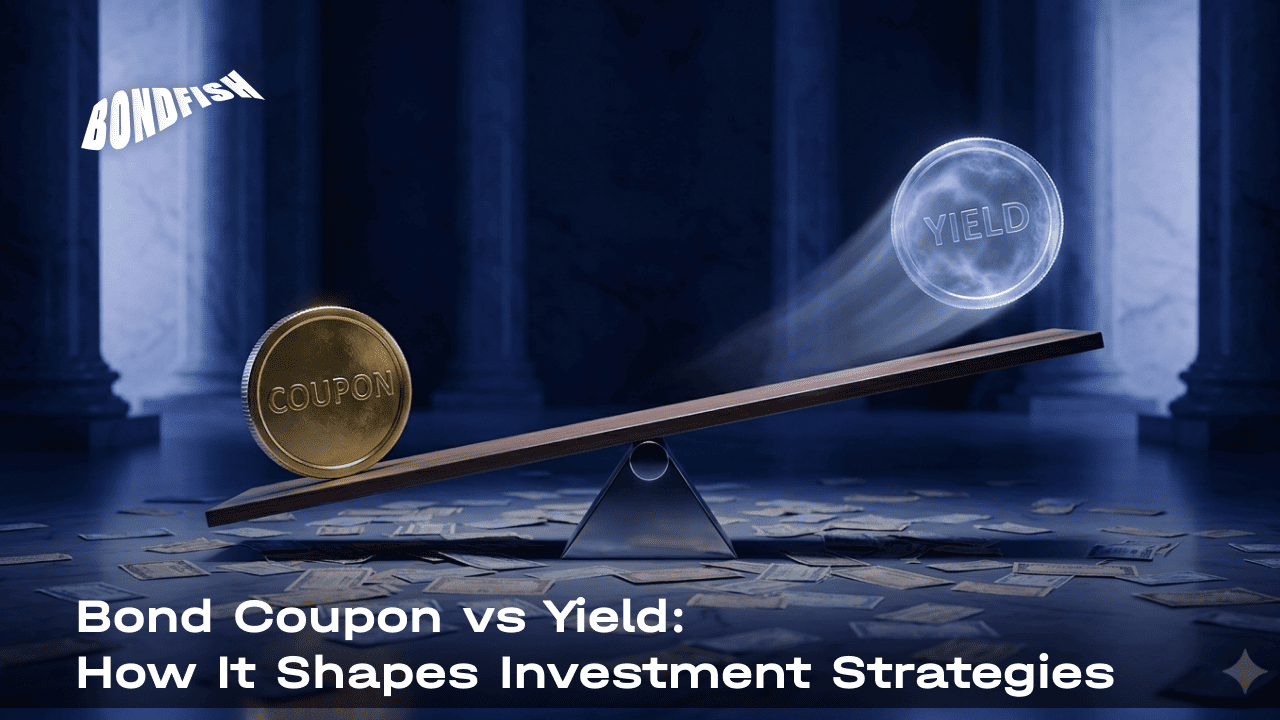
This is the core relationship behind bond coupon vs yield. A bond’s coupon rate is the fixed percentage of its par value that it pays in interest each year, while its yield represents the actual return an investor earns based on the bond’s current market price. The coupon rate tells the investor what the bond pays. The yield tells the investor what the bond may earn relative to the price paid.
For example, assume a bond has a face value of €1,000 and a coupon rate of 5,0%, meaning annual interest of €50. If the bond’s market price is also €1,000, the current yield is 5,0%. If the current price rises to €1,100, the same €50 of fixed coupon payments represents a current yield of about 4,5%. If the market price falls to €900, the same €50 of annual interest represents a current yield of about 5,6%. The coupon payments are unchanged, but the return relative to the purchase price changes materially.
Bond prices and yields move in opposite directions. When bond prices rise, yields fall, and when bond prices fall, yields rise, reflecting an inverse relationship between price and yield. This inverse relationship is central to evaluating bonds because most bonds trade actively in the secondary market before maturity.
When interest rates rise, newly issued bonds usually come with higher coupon rates or higher yields. Existing bonds with lower coupon rates become less attractive, so their bond's market price often falls. As the bond’s market price declines, the bond yield rises because the fixed interest payments are now being earned on a lower purchase price. Conversely, when interest rates fall, existing bonds with higher coupon rates become more valuable. Their bond's market price rises, and yield falls.
This relationship explains why bond prices fluctuate even when the bond issuer continues making all scheduled coupon payments. The fixed annual interest may be unchanged, but market conditions change around the bond. Investors constantly compare the bond relative to new opportunities available in the bond market. If the old coupon rate looks attractive compared with current market interest rates, investors may pay a premium. If it looks unattractive, investors may demand a discounted price.
A bond trading at par has a market price close to its face value. In that case, the coupon rate, current yield, and maturity yield may be relatively close, although they are not always identical. The picture changes when bonds trade at a premium or discount. If a bond is purchased at a premium, its yield will be lower than its coupon rate. If it is purchased at a discount, its yield will be higher than its coupon rate.
Consider a bond with a €1,000 par value and a 7,0% coupon rate. It pays €70 of annual interest. If investors pay €1,150, the current yield is about 6,1%, because the interest payment is measured against a higher current market price. The investor also faces a potential capital loss if the bond matures at €1,000, below the purchase price. This reduces yield to maturity.
Now consider the same bond purchased at €850. The current yield is about 8,2%, and the investor may also benefit from capital gains if the bond matures at its face value. This is why discounted price opportunities can be attractive, although they may also reflect higher credit risk, liquidity concerns, or adverse market conditions.
Current yield is calculated by dividing the bond's annual coupon payment by its current market price. It provides a simple measure of the income generated relative to the bond's price. This is useful for investors focused on income, but it does not capture the full economics of the investment. It ignores the capital gain or loss that may occur if the bond matures at face value, and it does not fully reflect the time left until maturity.
Yield to maturity is more comprehensive. Yield to maturity YTM is the total return an investor can expect to earn if a bond is held until it matures, assuming all contractual cash flows are received. It takes into account annual coupon payments, the difference between the purchase price and the face value, and the time left until maturity. The yield to maturity therefore combines income and pull-to-par effects.
The yield to maturity of a bond accounts for the total expected return if the bond is held until maturity, considering the bond's current price, coupon payments, and time to maturity. For investors comparing two bonds with different coupon rates and different market prices, yield to maturity is usually a more useful measure than coupon rate alone. It allows investors to compare bonds effectively across premium bonds, discount bonds, and par bonds.
A simplified way to calculate yield to maturity is to consider the bond's cash flows, including coupon payments and the difference between the face value and the current price, divided by the average of the face value and current price, adjusted for the time to maturity. In practice, professional systems calculate yield to maturity using discounted cash flow methods, because the timing of each coupon payment matters.
Interest rates are one of the main drivers of bond prices. When market interest rates rise, existing bonds with lower coupon rates become less attractive, causing their prices to drop and yields to increase. When interest rates fall, bonds with higher coupon rates become more valuable, causing their prices to rise and yields to fall. This is why long term bonds are often more sensitive to future interest rates than short term bonds.
The reason is duration. A bond with many years of fixed coupon payments has more future cash flows exposed to changing discount rates. If interest rates rise sharply, the present value of those future fixed interest payments declines. As a result, bond prices may fall more for longer maturity securities than for short maturity securities, all else equal.
The yield curve also matters. A normal yield curve usually shows higher yields for longer maturities, compensating investors for time, inflation uncertainty, and duration risk. A flat yield curve suggests that short and long maturity yields are close to each other, often reflecting uncertainty about growth and monetary policy. An inverted yield curve, where short maturity yields exceed long maturity yields, can signal expectations of lower future interest rates or weaker economic growth.
Bond yield is not driven by interest rates alone. Market conditions, inflation expectations, economic growth, credit risk, liquidity, and supply also influence the yield rate investors demand. Higher inflation expectations typically lead to higher bond yields, because investors seek to maintain the purchasing power of future interest payments. If inflation is expected to erode the real value of coupon payments, investors may require a higher yield to compensate investors for that risk.
Credit risk is another major factor. Corporate bonds issued by companies with lower credit ratings usually offer higher yield than government bonds or investment grade issuers with stronger balance sheets. A weaker credit rating increases the probability that the issuer may struggle to repay debt or refinance obligations. As a result, investors demand additional compensation above the risk-free or government bond curve.
Supply also plays a role. The supply of bonds is influenced by government borrowing and corporate financing needs. When issuance is heavy and demand is limited, an oversupply can lead to higher yields, as issuers must offer more attractive returns to entice buyers. This can affect both newly issued bonds and existing bonds in the secondary market, particularly when investors have many comparable choices.
The distinction between coupon rate vs yield matters because investors use bonds for different objectives. Investors focused on steady cash flow may focus on the coupon rate, because it defines the regular income stream. For retirees, foundations, or conservative private investors, fixed coupon payments can support income planning. A higher coupon rate can also reduce reliance on selling bonds to generate liquidity.
Investors seeking total return may prioritize yield to maturity. They may be less interested in the coupon rate itself and more focused on the combined effect of annual interest, purchase price, pull-to-par, and potential capital gains. For these investors, a lower coupon bond bought at a discount may be more attractive than a high coupon bond trading at a large premium, depending on maturity, credit risk, and the current market price.
The overall return for bondholders combines fixed coupon payments and capital gains or losses from selling before maturity. If an investor plans to hold until the bond matures, yield to maturity may be the main reference point. If the investor expects to sell bonds before maturity, market price fluctuations become more important. A bond can pay attractive coupon payments and still generate a negative total return if its market price declines enough before sale.
Evaluating bonds requires more than ranking securities by coupon rate. Two bonds can have the same coupon rate but very different yields because they trade at different prices. Conversely, two bonds can have different coupon rates but similar yield to maturity because one trades at a premium and the other trades at a discount.
A practical comparison should include coupon rate, current yield, yield to maturity, maturity date, credit rating, issuer quality, currency, liquidity, and call features. Investors should also check whether the bond is callable, because early redemption can change the realised return. If a high coupon bond can be called soon at par value, its attractive coupon rate may be less valuable than it first appears.
The bond's face value, the bond's market price, and the purchase price should always be considered together. The coupon rate explains fixed annual interest. The current market price explains what investors pay today. The bond yield rate explains the return implied by that price. Without all three, the investor has only a partial view of the investment.
One common mistake is assuming that a high coupon rate means a high return. A bond with a high coupon rate may trade at a premium, reducing yield to maturity. Another mistake is assuming that a low coupon rate means a weak investment. A low coupon bond bought at a discounted price can offer a higher yield and potential capital gains if credit quality remains stable and the bond matures at par value.
A second mistake is ignoring the difference between current yield and yield to maturity. Current yield focuses only on annual interest relative to current price. Yield to maturity includes the full path to repayment at face value. For discount bonds, current yield may understate total expected return because it ignores the gain from purchase price to par value. For premium bonds, current yield may overstate total expected return because it ignores the loss from purchase price to face value.
A third mistake is treating yield as purely mechanical. Bond yield reflects the market's assessment of rates, credit risk, liquidity, inflation, and supply-demand balance. A higher yield may be attractive, but it may also signal higher risk. Lower yields may appear less appealing, but they can reflect stronger credit quality, better liquidity, or defensive characteristics during market stress.
Understanding the relationship between coupon and yield is crucial for assessing bond performance and investment strategy. The coupon rate provides cash flow visibility. Bond yield provides market-based return information. Yield to maturity connects the purchase price, coupon payments, time to maturity, and face value into one return estimate.
For income strategies, the coupon rate helps investors assess expected cash receipts. For total return strategies, yield to maturity helps investors evaluate expected performance if the bond matures as scheduled. For tactical strategies, market price fluctuations, interest rates, and credit spreads may matter more than the coupon rate itself.
In the bond market, the right question is rarely whether a bond has a high coupon rate or a low coupon rate. The better question is whether the yield adequately compensates the investor for duration, credit risk, liquidity, currency exposure, and the possibility that market conditions change before maturity.
The practical challenge for many investors is that coupon rate, current yield, yield to maturity, market price, credit rating, maturity, and broker availability are often scattered across different sources. This makes bond investments harder to compare than they should be, especially for retail investors who do not use institutional terminals.
Bondfish is designed to address this problem by making bond analysis more accessible. The platform helps investors screen bonds, review key yield and price data, compare issuers, and understand whether a bond is available through selected brokers. For a topic like coupon rate vs yield, this matters because investors need to see both the contractual cash flow and the market-implied return in one place.
The main lesson is simple but important: coupon rate defines what the bond pays, while yield indicates what the investor may actually earn at the current market price. Bondfish helps bring these moving parts together, so investors can evaluate bonds with a clearer view of income, return, price sensitivity, and credit risk.