A grade investments in bonds are simply high-quality, highly rated bonds — those rated BBB-/Baa3 and above — and you find them by screening for credit rating across Treasuries, investment-grade corporate bonds, and high-quality municipals. The easiest entry points are the bond desks of major online brokers and a handful of low-cost investment-grade ETFs — both let you filter by rating before you buy.
“A grade” is loose investor shorthand for the safest, most creditworthy bonds — the ones rated highly enough that default is a remote risk rather than a daily worry. In mid-2026 that quality comes with a real payoff: broad investment-grade bonds yield roughly 5%, the most generous carry in over a decade. The trick is locating the right bonds without overpaying for safety. This guide shows you exactly where to look and how to vet what you find.
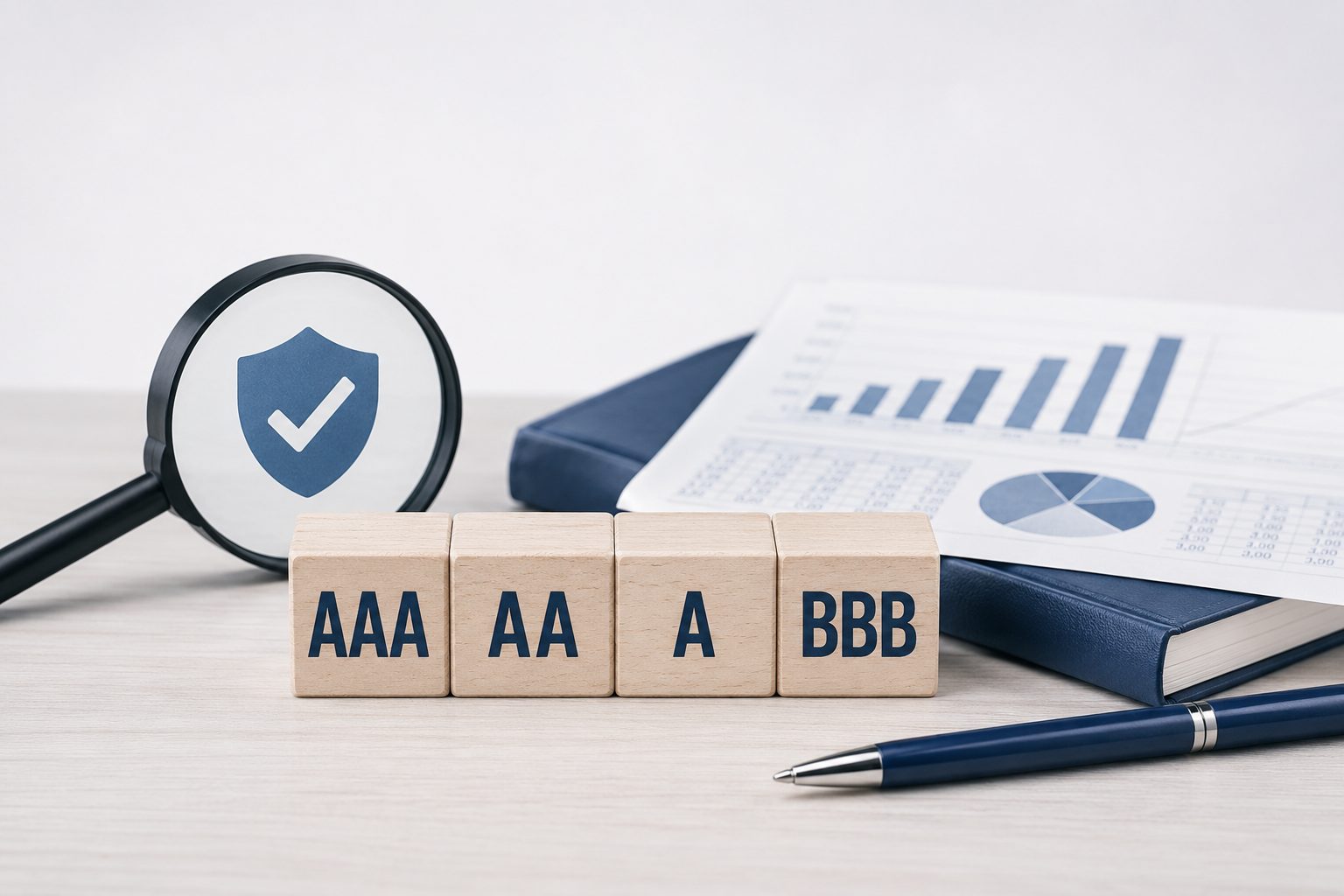
Before you hunt, get the vocabulary straight. The three major agencies — S&P Global, Moody’s, and Fitch — grade bonds from strongest to weakest. S&P and Fitch use letters (AAA, AA, A, BBB…); Moody’s uses a lookalike scale (Aaa, Aa, A, Baa…). Everything from BBB-/Baa3 and up is “investment grade”; everything below is “speculative” or “high yield” (often called junk).
People use “A grade investments” two ways, and both are reasonable:
The single most important line on the whole scale is the one between BBB- and BB+ (Baa3 and Ba1 at Moody’s). That one notch separates investment grade from junk — and it’s the threshold most cautious investors refuse to cross. Higher up the ladder means lower default risk but usually a lower yield, so “A-grade” is often the sweet spot between safety and income.
A credit rating is an opinion about the odds of getting paid back — not a guarantee. Treat it as a starting filter, not the final word.
You don’t need a Bloomberg terminal. Here are the practical places retail investors actually source A grade investments, from simplest to most hands-on.
The fastest way to surface A-grade bonds is a screener that lets you filter by rating, yield, maturity, and sector. You set the floor — say, “A- or better, 2–7 years, yield above 4.5%” — and the tool returns matching bonds with their ISINs. The Bondfish bond screener is built for exactly this: screening bonds by rating and yield so you compare like with like before committing capital.
Most major brokers run a fixed-income marketplace where you can buy individual investment-grade bonds directly. Fidelity, Charles Schwab, E*TRADE, and Interactive Brokers all let you search by credit rating, maturity, and yield, then place an order much like a stock. Individual bonds give you a fixed coupon, a known maturity date, and the option to hold to par — useful if you want predictable cash flows on a schedule.
If you want diversification without picking individual issues, a low-cost fund spreads your money across hundreds or thousands of investment-grade bonds in one trade. Widely held options include:
The trade-off: an ETF never matures, so its price floats with rates and you don’t get a guaranteed return of principal on a set date. For investors who want a ready-made shortlist, our current bond picks highlight specific investment-grade names worth a closer look.
U.S. Treasuries are the highest-quality bonds in the dollar market — effectively the benchmark every other bond is priced against. You can buy them commission-free at any broker or directly from the government at TreasuryDirect.gov. With the 10-year Treasury near 4.54% in June 2026, they set the floor that A-grade corporates are paid above. (U.S.-specific; investors elsewhere have equivalents such as German Bunds, U.K. Gilts, or Italian BTPs. etc.).
For U.S. taxable-account investors, highly rated municipal bonds can deliver A-grade credit quality with interest that may be exempt from federal (and sometimes state) tax. They’re available through the same broker bond desks and dedicated muni funds. Whether they beat a taxable corporate depends on your tax bracket, so compare the tax-equivalent yield, not just the headline coupon.
Finding a high rating is step one. A quick checklist keeps you from overpaying for safety or missing a hidden risk:
The good news is income: all-in investment-grade yields have ranged from roughly 4.7% to 5.4% this year, the strongest in over a decade. The caution is valuation. Credit spreads — the extra yield over Treasuries — have compressed to multi-decade tights, so investors are getting historically little compensation for taking on default risk. In practice that argues for staying disciplined on quality and not reaching down the rating ladder just to squeeze out a few extra basis points. When spreads are this thin, the safest A-grade bonds are often the better risk-adjusted deal.
A-grade bonds — investment-grade debt rated BBB-/Baa3 and above — are within easy reach of any retail investor through a bond screener, an online broker’s bond desk, ищтв ETFs, Treasuries, or high-grade municipals. With yields near 5% but credit spreads unusually tight in 2026, the winning move is to screen by rating first, vet each bond against the checklist, and resist reaching for risk you’re not being paid to take.
This article is for general information only and is not investment advice. Bond investing involves risk, including possible loss of principal. Yields and spreads cited are as of early June 2026 and change daily. Consider your own circumstances or consult a licensed financial professional before investing.