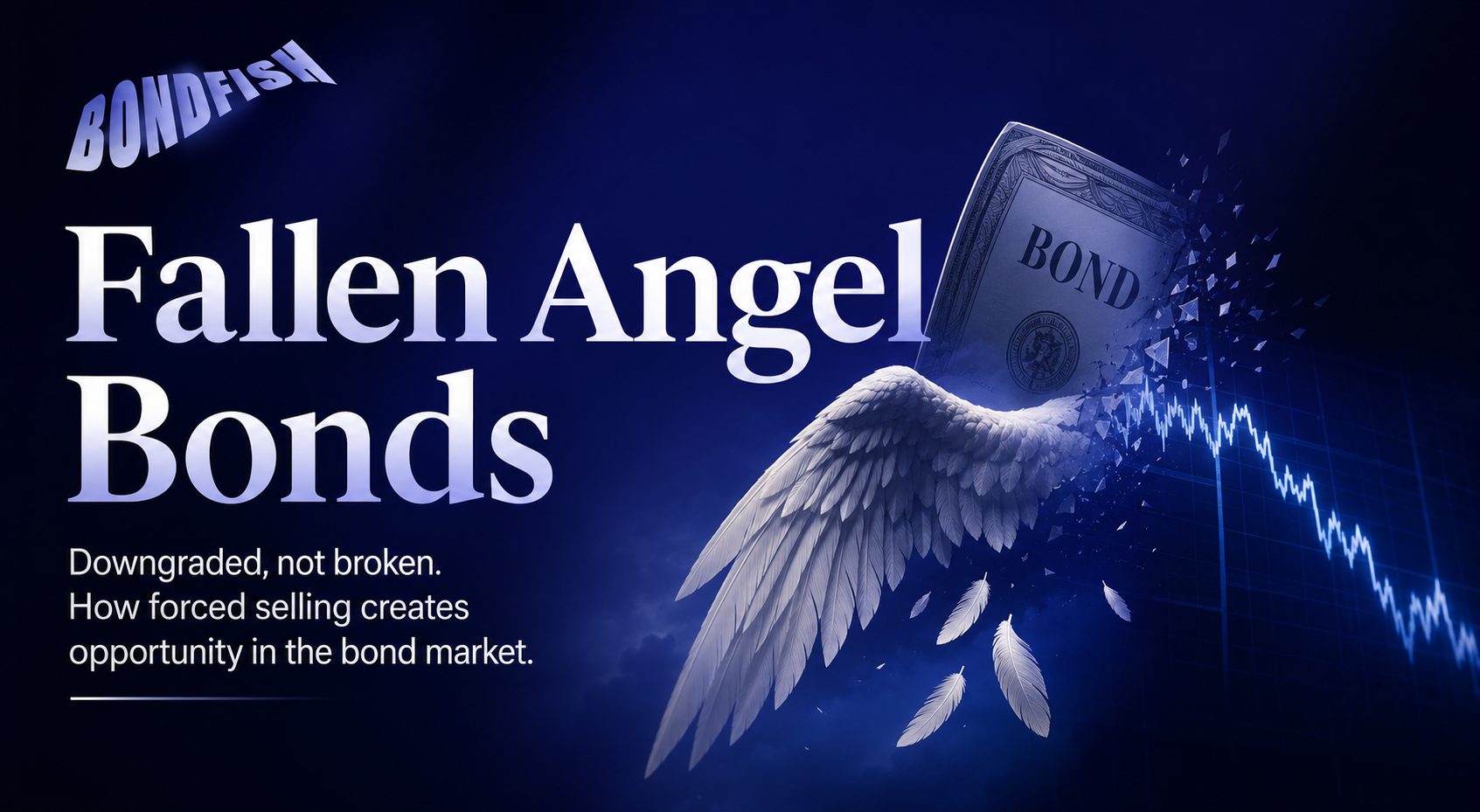
Fallen angel bonds are bonds that were rated investment grade but have since been downgraded to junk (high-yield) status. The label matters because the downgrade itself triggers forced selling — and that selling frequently pushes the price below what the bond is worth.
Last week gave us a clean example of the line being crossed in both directions. As last week’s bond digest noted, Electronic Arts was cut from a solid investment-grade rating down to high yield — a textbook fallen angel — while Seagate went the other way, upgraded into investment grade as a “rising star.” Those are not just labels. Crossing the investment-grade boundary changes who is allowed to own the bond, and that is where the money moves.
Fallen angel bonds are corporate or government bonds that start life rated investment grade and are later downgraded into speculative, or “junk,” territory. The dividing line sits between the lowest investment-grade rung and the highest junk rung: a bond drops from BBB− (Baa3) to BB+ (Ba1) or lower. The mirror image — a rising star — travels upward across the same line, as Seagate did last week when it earned its way back into investment grade.
Fallen angels are not the same as bonds that were born junk. Because these issuers were investment grade until recently, they tend to be larger, better-documented companies clustered at the top of the high-yield ladder. Roughly three-quarters of the fallen-angel universe carries a BB rating — the highest junk tier — rather than the riskier B or CCC rungs. One consequence: fallen angels have historically defaulted less often than original-issue junk, with a 12-month default rate near 3.5% versus about 4.5% for comparable speculative-grade bonds.
The sell-off has little to do with whether the company can pay you back next month. It is mechanical. A large share of the world’s bond money is only permitted to hold investment-grade paper — pension funds, insurers, and the many index funds that track investment-grade benchmarks. When a bond is cut to junk, those holders must sell, often within a set window, whatever the price.
The result is a price that typically weakens ahead of the expected downgrade and reaches its lowest point right around the downgrade date. In other words, the bond can be cheapest precisely when the bad news is already public knowledge.
A fallen angel is often sold not because it is broken, but because its owners are no longer allowed to hold it.
Once the forced sellers are done, the pressure lifts. Buyers who are free to own high-yield bonds — and who judge the company on its cash flows rather than its rating label — step in at the marked-down price. Historically, much of the price recovery has arrived within three to six months of the downgrade, though in recent cycles, as the size of downgrade waves has grown, that window has stretched by roughly a quarter.
This is why fallen angels have earned a following. As a group, they have outpaced the broad high-yield market in the majority of calendar years over the past two decades, helped by that repeated pattern of forced markdown and recovery. That is a historical tendency across a diversified basket, not a promise about any single bond — a company can be downgraded because it is genuinely deteriorating, and some fallen angels keep falling. The edge comes from the mechanics of the selling, not from the downgrade being “wrong.”
The reason this matters for the week ahead is that the pipeline of potential fallen angels is filling up. Around $100 billion of debt that still carries an investment-grade rating has recently been trading at the wider spreads you would normally see on junk — the market’s way of pricing in downgrades before the rating agencies act. Names flagged in the financial press include heavily indebted issuers such as Oracle and Stellantis, whose spreads have drifted toward speculative levels as they fund large capital plans.
The backdrop is a still-elevated cost of borrowing. The U.S. 10-year Treasury yield sat near 4.65% in early August, and companies that loaded up on cheap debt years ago now face refinancing at much higher rates. For context on how much extra return the junk market is currently paying over Treasuries, the high-yield spread — measured by the ICE BofA US High Yield Index Option-Adjusted Spread — was about 2.70% (roughly 270 basis points) in early August, versus about 0.78% for investment-grade corporates. Those are historically tight levels, which means investors are being paid relatively little to take credit risk today — and relatively little cushion if a wave of downgrades arrives.
You do not need a trading desk to see a downgrade coming. The warning signs are visible in public filings and in the price of the bond itself.
This is exactly the kind of screening our tools are built for. You can filter thousands of bonds by credit risk, yield, and maturity using the Bondfish bond screener, and each issuer carries a live credit-risk rating of Low, Medium, or High so you can flag the holdings sitting closest to the edge. If you would rather see specific names our team is watching, browse our current bond picks.
Fallen angel bonds are investment-grade bonds pushed into junk, and the downgrade triggers forced selling that often marks the price below fair value before it recovers. With spreads tight and several large issuers already trading like junk, the coming months could bring more crossings of the investment-grade line — a risk if you hold low-BBB bonds, and a source of opportunity for investors who understand the mechanics.
This article is for general information only and is not investment advice. Bond investing involves risk, including possible loss of principal. Consider your own circumstances or consult a licensed financial professional before investing.