
Eng
Bond screener Top picks Broker Comparison Prices News About us
Help us personalize your Bondfish experience
To make your bond exploration seamless and ensure our recommendations deliver maximum value, please answer 3 quick questions:
This will take less than a minute and helps us tailor the platform to your needs.
What do you want to know about bonds?
You can use natural language command or identifier, if the instument is known
Thinking...
%%ask%%
%%html%%
%%answer%%
User wants average coupon, grouped per quarter, for "best" long-term (likely 10+ years) bonds, lowest risk, limited to German and French issuers.
Identifies the need to:
  • Find relevant fields for coupon, maturity date, risk, issuer country (for bonds)
  • Find fields for country, risk (for issuers)
Using tool to resolve which instrument (bond) fields map to:
  • "average coupon"
  • "maturity date"
  • "risk level"
  • "issuer country"
Using tool to resolve issuer fields for:
  • "country"
  • "risk level"
Converting "German issuers" into structured issuer query
Converting "French issuers" into structured issuer query
Back
29.10.2026
France’s Budget Crisis: Why Markets Price an Aa3-Rated Country Like a Weaker Credit
22

In the France debt crisis, bonds are pricing where French public finances are heading, not the country’s credit rating. On October 29, 2026, the 10-year French government bond (OAT) yielded 4.88%, or 152 basis points (bp) more than Germany’s 10-year Bund. That premium is wider than Italy’s (113bp, rated BBB+ by S&P) and Greece’s (94bp, rated BBB), and 2.5 times Spain’s (61bp), which S&P rates A+, the same as France. Moody’s still rates France Aa3. Investors are looking past the letter grade to a deficit stuck at around 5% of GDP, debt heading for about 122% of GDP, an interest bill set to reach about €91 billion in 2027, and a parliament without a majority to pass a budget.

For most of the euro’s first decade, France borrowed almost as cheaply as Germany: from 2000 to 2007 its 10-year spread over Bunds averaged just 7bp. On October 21, 2026, the 10-year OAT yield closed at 5.01%, the first close above 5% since July 2002. The next day it closed at 5.08% and the spread hit 174bp, the widest since November 2011, at the height of the euro crisis. At the close on October 22 and 23, France even paid more than the United States to borrow for 10 years.

How Far French Bond Yields Have Moved in 2026

The cleanest gauge of how markets see France is the spread: the extra yield investors demand to hold a French bond instead of the German bond of the same maturity. Germany is the euro area’s benchmark borrower, so the gap strips out the European Central Bank’s interest rates and isolates what is specific to France. (Our guide explains what a bond spread is in more detail.)
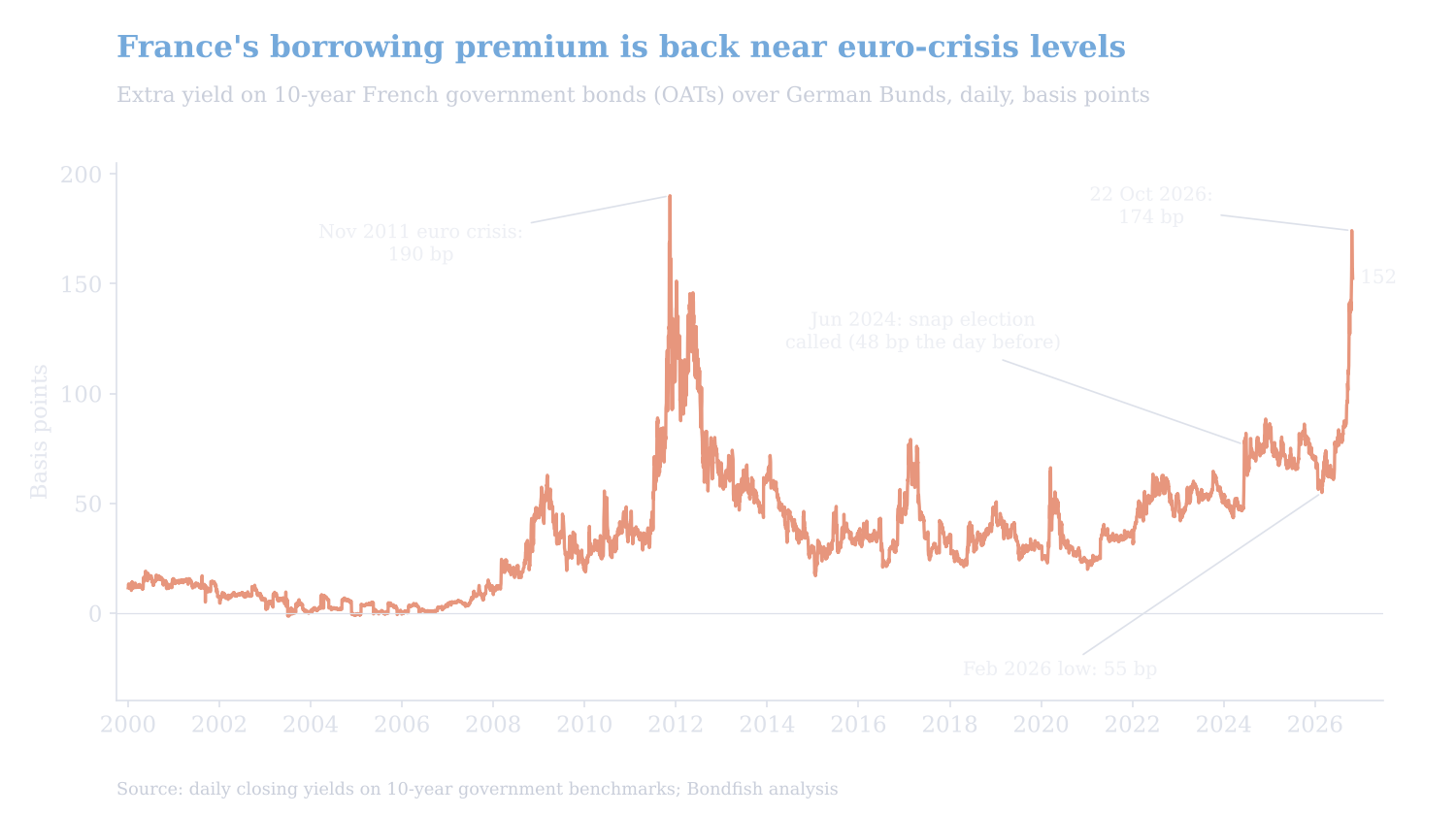
France debt crisis bonds chart: the 10-year OAT-Bund spread rose from 55bp in February 2026 to 174bp on October 22, close to its November 2011 record of 190bp

Yield on the 10-year French government bond (OAT) minus the 10-year German Bund, daily closes, January 2000 to October 29, 2026. Source: daily closing yields on 10-year government benchmarks; Bondfish analysis.

The spread started 2026 at 71bp and fell to a low of 55bp on February 25. It then more than tripled in eight months, with most of the move after the summer: it ended September at 127bp and peaked at 174bp on October 22. It closed at 152bp on October 29.

The pressure has been building since June 2024, when President Emmanuel Macron dissolved the National Assembly and called a snap election. The spread jumped from 48bp to 77bp within a week. The vote produced a parliament split into three blocs with no majority, and France has struggled to pass a budget ever since. The 2026 budget was only adopted on February 2, 2026, using Article 49.3 of the constitution, which lets the government pass a bill without a vote unless it loses a no-confidence motion.

France Debt Crisis: Bonds Priced Below Their Credit Rating

France’s three main ratings still sit in the upper half of the investment-grade scale: Aa3 at Moody’s (the equivalent of AA-, with a negative outlook since October 2025) and A+ at S&P Global Ratings and Fitch, which both cut France by one notch in autumn 2025. On S&P’s scale, A+ is three notches above Italy’s BBB+ and four above Greece’s BBB. Bond markets are paying no attention to that ranking.
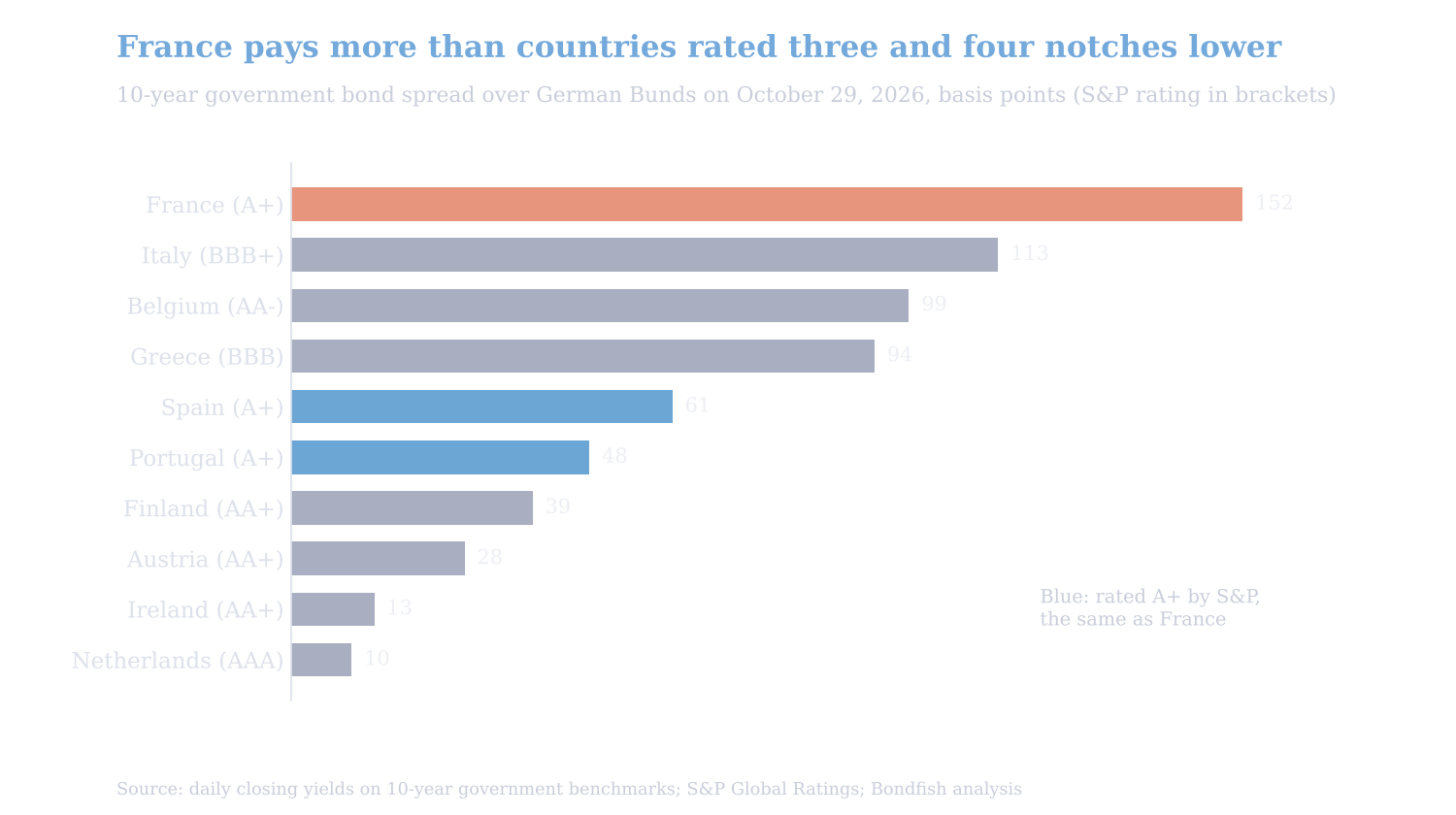
10-year spreads over German Bunds on October 29, 2026: France 152bp (A+), Italy 113bp (BBB+), Belgium 99bp (AA-), Greece 94bp (BBB), Spain 61bp (A+), Portugal 48bp (A+)

Yield on each country’s 10-year government bond minus the 10-year German Bund at the October 29, 2026 close; S&P long-term rating in brackets. Source: daily closing yields on 10-year government benchmarks; S&P Global Ratings; Bondfish analysis.

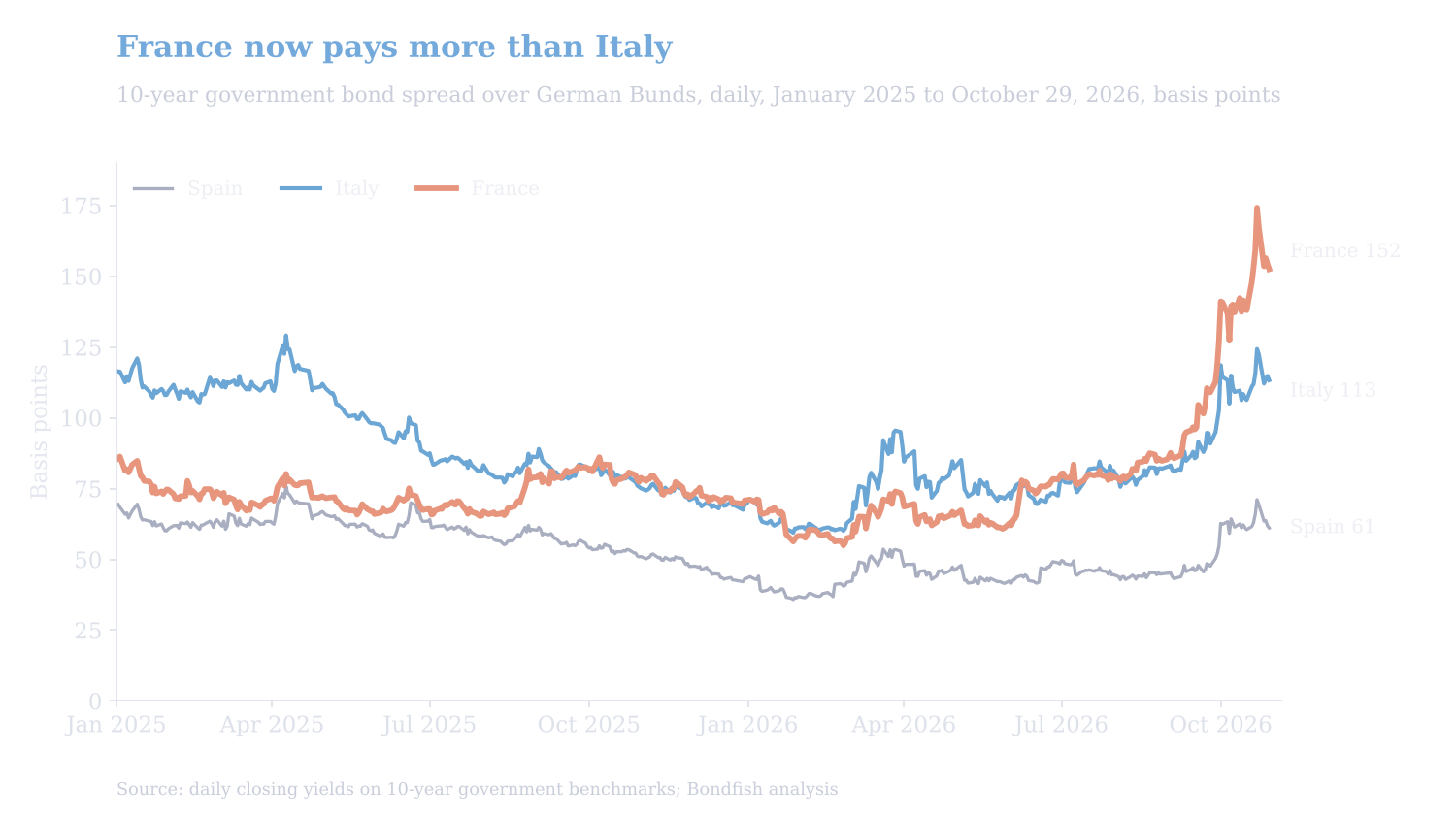
  • France pays more than lower-rated Italy. On October 29, the 10-year OAT yielded 39bp more than the 10-year Italian BTP. At the peak on October 22 the gap was 50bp. As recently as March 26, 2026, France still paid 22bp less than Italy.
  • Same rating, very different price. Spain and Portugal also carry an A+ rating from S&P, but their 10-year spreads are 61bp and 48bp, against France’s 152bp.
  • Downgrades barely moved the market. When Fitch and S&P cut France to A+ in September and October 2025, the spread stayed close to 79bp. The market had largely priced the downgrades in advance, and in 2026 it moved far ahead of the agencies again.

Why Bond Markets and Rating Agencies Disagree on France

A credit rating and a bond spread answer different questions. A rating is a judgment about the risk of default over many years. A spread is a price set every day by investors who can sell tomorrow. In France’s case, five things separate the two.
  1. Ratings reward wealth and institutions; markets price momentum. When Fitch affirmed France at A+ on August 28, 2026, it cited a large, diversified, high-income economy and a solid banking sector. Those strengths do not change quickly. What investors are watching is the direction of travel, and it is pointing the wrong way.
  2. France’s debt keeps rising while Italy’s story improves. French public debt rose from 112.6% of GDP at the end of 2024 to 119.0% in June 2026, according to the national statistics office INSEE. Italy, meanwhile, has been collecting better grades: Moody’s upgraded it to Baa2 in November 2025, and S&P moved its outlook to positive in January 2026.
  3. No majority, no budget. Prime Minister Sébastien Lecornu’s government has no absolute majority in the National Assembly. The Assembly rejected the 2027 social security budget on October 23, and the vote on the revenue half of the state budget has been pushed back to November 3. The presidential election follows in April and May 2027, so the political uncertainty has a long tail.
  4. No easy safety net from the ECB. The European Central Bank’s Transmission Protection Instrument (TPI) lets it buy a country’s bonds to stop a disorderly sell-off, but only for countries that meet its conditions. The first is compliance with EU fiscal rules: a country should not be under the EU’s excessive deficit procedure or, if it is, should not have been found to be failing to correct its deficit. France has been under that procedure since 2024. Its agreed path caps growth in net primary spending at about 1.2% a year and requires the structural primary balance to improve by about 0.5% of GDP in 2027, which depends on a budget that does not yet have a majority. On October 29 the ECB held its deposit rate at 2.5%, and President Christine Lagarde said the bank has instruments to respond to disorderly markets while declining to comment on France directly.
  5. A lot of bonds to sell, much of it to foreign investors. The 2027 budget bill sets €340 billion of new medium- and long-term state bonds, net of buybacks, up from €310 billion in 2026. Non-residents held 57.5% of France’s tradable government debt in the first quarter of 2026, according to the Banque de France, and foreign investors were the largest net buyers of French government debt in the first half of the year, according to ECB securities holdings data. That demand was already fading before the October sell-off: euro-area balance-of-payments data show that purchases of French debt securities by investors outside France slowed to about €2 billion in August, after several months of heavy buying. A buyer base that large and that international can step back quickly when sentiment turns.

10-year spreads over German Bunds since January 2025: France rose above Italy in 2026 and reached 152bp on October 29, against 113bp for Italy and 61bp for Spain

Yield on 10-year French, Italian and Spanish government bonds minus the 10-year German Bund, daily closes, January 2, 2025 to October 29, 2026. Source: daily closing yields on 10-year government benchmarks; Bondfish analysis.

The Numbers Behind the France Debt Crisis: Deficit, Debt and Interest

The government’s own figures explain why investors want more yield. The deficit, which fell to 5.1% of GDP in 2025, is now expected at 5.4% this year. The 2027 budget bill, presented to the cabinet on October 1, targets 5.0% and still has debt rising to 121.7% of GDP.

YearDeficitDebtInterest bill
2024 5.8% 112.6% €58.1bn
2025 5.1% 115.6% €64.7bn
2026 (forecast) 5.4% 119.3% about €79bn
2027 (budget bill) 5.0% 121.7% about €91bn

France’s public finances, general government. Deficit and debt in % of GDP; interest bill = general government interest payments. 2024 and 2025: INSEE. 2026 and 2027: government forecasts in the 2027 budget bill (interest as reviewed by the High Council of Public Finances).

  • The interest bill is the fastest-growing item. General government interest payments rose from €58.1 billion in 2024 to €64.7 billion in 2025. The 2027 budget bill sees them reaching about €91 billion in 2027, roughly 41% more than in 2025.
  • Higher yields feed through slowly, but they feed through. The average maturity of France’s tradable debt is eight years and five months, according to the French Treasury’s debt agency (Agence France Trésor). Even so, the state’s financing need rises to €339.7 billion in 2027, €28 billion more than in 2026, mainly because about €19 billion more old debt falls due. That includes about €189 billion of maturing debt that will be refinanced at today’s higher rates, on top of new borrowing to cover the deficit.
  • The official watchdog doubts the forecasts. France’s High Council of Public Finances (HCFP) called the government’s 1.0% growth forecast for 2027 “optimistic” and said bringing the deficit below 3% of GDP in 2029, as planned, is very unlikely. Fitch projects a 2027 deficit of 5.5%, not 5.0%.

What the France Debt Crisis Means for OAT Holders

The sell-off has not been limited to 10-year bonds. French yields have risen across the curve, and the gap with Germany has widened at every maturity, even at two years.

MaturityFrance yieldGermany yieldSpread nowSpread 25 Feb
2-year 3.64% 3.08% 57 12
5-year 4.28% 3.16% 112 28
10-year 4.88% 3.35% 152 55
30-year 5.37% 3.68% 168 84

French and German government bond yields at the October 29, 2026 close, and France’s spread over Germany in basis points, then and on February 25, 2026 (the 2026 low for the 10-year spread).

For anyone who bought French government bonds earlier this year, the cost is real. A 10-year OAT bought at par on February 25, when the 10-year yield was 3.26%, would now be worth about 88 per 100 of face value. Counting the interest earned since then, that is a loss of about 10%. A 30-year OAT bought the same day at 4.21% would be down about 14%.

A new 10-year OAT bought at today’s yield has a modified duration of about 7.8. Put simply, its price would fall by roughly 7.8% for every further 1 percentage point rise in yield, and rise by about as much if yields fell back.

Four points are worth keeping in mind:

  • Price risk is not default risk. An OAT held to maturity still pays every coupon and its full face value unless France defaults. Every major agency rates France in the upper half of investment grade, and none has signalled that a default is likely.
  • The extra yield is compensation, not a gift. New buyers can lock in 4.88% for 10 years and 5.37% for 30 years, against 3.35% on the 10-year Bund. That gap is the market’s price for the risks above, and it could widen further before it narrows.
  • Check what your funds hold. France is one of the largest borrowers in the euro government bond market, so broad euro government bond funds and ETFs typically hold a large share of OATs.
  • Compare before you buy. You can use the Bondfish bond screener to compare French government bonds with other euro-area issuers by yield, maturity and rating.

Key Dates for French Government Bonds Through Spring 2027

  • November 3, 2026: National Assembly vote on the revenue half of the 2027 state budget.
  • November 17, 2026: Assembly vote on the full state budget, which then goes to the Senate.
  • November 27, 2026: scheduled S&P review of France’s rating.
  • December 17, 2026: the 70-day limit for parliament to act on the budget runs out; after that, the constitution lets the government enact it by ordinance.
  • April 18 and May 2, 2027: first and second rounds of the presidential election.

The Bottom Line

France’s ratings describe a rich country with strong institutions that can pay its debts. Its bond yields describe a country whose debt keeps rising, whose budget has no majority behind it and whose central bank backstop comes with strings attached. At 152bp over Bunds, more than Italy or Greece pays, the market has effectively priced France as a weaker credit than its Aa3 and A+ ratings imply. Whether that gap closes depends on the budget votes in November and December and on the 2027 election, not on the agencies. For bondholders, the risk today is price swings, not default.

Data and sources

Government bond yields: daily closing yields on generic 2-, 5-, 10- and 30-year government benchmarks for France, Germany, Italy, Spain, Belgium, Greece, Portugal, Finland, Austria, Ireland and the Netherlands, January 2000 to October 29, 2026; U.S. 10-year Treasury closing yields for October 2026. Spreads, the price and return of the hypothetical OATs bought on February 25, 2026 (annual coupon equal to that day’s yield) and modified duration are Bondfish’s own calculation. Credit ratings: S&P Global Ratings, Moody’s and Fitch Ratings as of October 29, 2026. Public finances: INSEE (2024–2025 and June 2026) and the government’s 2027 budget bill (2026–2027). Debt structure and financing: Agence France Trésor (2027 financing programme) and Banque de France. Holdings and flows: ECB securities holdings statistics and euro-area balance of payments. Fiscal path: EU excessive deficit procedure for France.

Official statistics and budget documents

Ratings and policy

This article is for general information only and is not investment advice. Investing involves risk, including possible loss of principal. Bond prices fall when yields rise, and past market moves do not predict future ones. Consider consulting a licensed financial professional before making investment decisions.

This article does not constitute investment advice or personal recommendation. Investments in securities and other financial instruments always involve the risk of loss of your capital. Past performance is not a reliable indicator of future results. Bondfish does not recommend using the data and information provided as the only basis for making any investment decision. You should not make any investment decisions without first conducting your own research and considering your own financial situation.