

Key thoughts
MEXEM feels less like a slick consumer app and more like a professional dealing desk with a European front door. It borrows the full Interactive Brokers inventory and toolkit, then wraps them in local-language onboarding and support. That combination gives European bond buyers a genuinely institutional menu — but it comes with a safety net and a fee structure that reward some investors and penalise others. Here is how each part works.
MEXEM launched in 2018 and grew quickly into a pan-European broker. It is regulated by the Cyprus Securities and Exchange Commission (CySEC) under CIF licence number 325/17, and is registered to operate across several other European markets.
The detail that shapes everything is this: MEXEM is an introducing broker to Interactive Brokers. It handles onboarding, the client relationship, and local-language support, while Interactive Brokers executes trades, clears them, and holds client assets — for European clients, through Interactive Brokers Ireland under Central Bank of Ireland supervision. For a bond investor, that means the depth, pricing, and platform come from Interactive Brokers, while the service layer and the compensation scheme come from MEXEM. Keeping those two layers separate is the key to understanding both its strengths and its limits. If you want the same inventory without the introducing-broker layer, it is worth comparing how the parent platform works in our guide to buying bonds via Interactive Brokers directly.
Opening an account is handled by MEXEM in your local language. You apply online and provide the usual identity and address documents; verification and support come from MEXEM’s team rather than from Interactive Brokers directly. Once approved, you fund the account by bank transfer in your base currency.
One practical note at funding: idle balances earn no interest (more on that below), so it is worth funding close to when you intend to buy rather than parking cash on the platform for weeks.
Protection splits into two layers worth keeping separate:
That €20,000 ceiling is the clearest limitation on the account. It protects against firm failure, not market losses — but the low cap is a real consideration for anyone holding a large bond position with a single provider. MEXEM itself is regulated by CySEC, a recognised but mid-tier European regulator.
The headline number is the draw: roughly 34,000 tradeable bonds, split about 30,000 corporate and 4,000 non-U.S. sovereign. The list spans multiple currencies and bond types — corporate, sovereign, and supranational.
Against European peers, MEXEM competes on breadth rather than polish. An app-first broker might list a few hundred bonds in a clean interface; MEXEM lists tens of thousands behind a professional platform. If your requirement is “find a specific ISIN in a specific currency,” the range is the reason to be here. With corporate issues making up the bulk of the menu, a screening pass beforehand keeps the depth workable — you can screen bonds by rating and yield on Bondfish to build a shortlist first, then search that specific ISIN inside MEXEM.
Unlike app-first brokers that let you buy a slice of a bond for a euro or two, MEXEM does not offer fractional bond trading. Orders are placed in the bond’s face-value lots. The offsetting point is that those lots are modest — retail-sized face values rather than the large institutional blocks some venues require — which keeps the deep menu genuinely usable for a normal portfolio, even if the entry ticket per bond is higher than on a fractional platform.
MEXEM does not run its own bond desk. Every order is passed to Interactive Brokers, which sources liquidity from a very wide set of venues: connections to 150-plus exchanges and market centres worldwide, plus IBKR’s own Alternative Trading System (ATS) — an internal, over-the-counter pool that matches orders off-exchange. For a bond buyer, that combined reach is why a given ISIN is more likely to be listed, and more likely to show a workable two-way quote, than on a small consumer app.
Where a bond can be routed more than one way, you generally have three choices, inherited from the Interactive Brokers platform:
The coverage is broad but not total: not every domestic exchange is wired in, so for a specific ISIN it is worth checking which route is actually available before you assume a quote exists. That caveat aside, SMART routing across the exchange-plus-ATS pool is exactly the institutional-grade sourcing a self-directed European investor is paying the introducing-broker layer to reach.
Bond commissions are tiered and percentage-based, plus external fees:
There is no custody or inactivity fee, and currency conversion is cheap at 0.05% with a roughly $5 minimum. Here is what the commission looks like at different ticket sizes on a European bond:
| Trade size (European bond) | Commission (from 0.1%) | Cost as % of trade |
|---|---|---|
| €1,000 | ~€1 | 0.10% |
| €5,000 | ~€5 | 0.10% |
| €20,000 | ~€20 | 0.10% |
On a €1,000 ticket, around €1 is excellent — well below what a traditional bank would charge to buy a single bond. But because the percentage has no cap, the absolute cost scales straight up: a €20,000 trade runs about €20, and a large single-bond order can get expensive fast.
The comparison that matters is with Interactive Brokers itself, because MEXEM routes every order there. MEXEM’s bond commissions track the IBKR fixed-income tariff, so on the same European bond you pay roughly the same headline rate — from 0.1% of trade value — whether you deal through MEXEM or hold an account with Interactive Brokers directly. The difference shows up on large tickets: IBKR’s own published European-bond schedule tiers down toward 0.025% on larger face values, while MEXEM presents a flat 0.1% with no cap. On a €50,000 bond that gap is real — roughly €50 at MEXEM versus a lower, tiered figure direct with IBKR — on top of the “plus external fees” add-on, which makes the all-in number harder to predict before you trade.
Cheap on a €1,000 bond, pricey on a €50,000 one — with no cap, MEXEM’s commission is a small-ticket bargain and a large-ticket tax.
The takeaway: for small-to-medium tickets the cost difference between MEXEM and a direct IBKR account is negligible, and MEXEM earns its layer through local-language support and localised tax reporting. For large or frequent single-bond orders, a direct Interactive Brokers account is cheaper and more transparent — so price-check the full cost of the ticket, not just the headline rate, before you buy.
Cash is the disappointment: MEXEM pays no interest on uninvested balances in any currency. Coupon income and idle euros earn nothing while they sit — a genuine drag if you hold cash between trades. This is the one area where an app-first competitor that sweeps cash into an interest-bearing account clearly beats MEXEM, so plan to keep only working balances on the platform.
This is the heart of using MEXEM, and because the platform is Interactive Brokers underneath, you have four ways to place a bond order: the web-based Client Portal, the mobile app, the installable Trader Workstation (TWS), and the standalone Bond Scanner. The two most convenient for finding and buying a specific bond are the Client Portal and the mobile app, because both support ISIN search; TWS and the standalone scanner are more powerful but make ISIN-based discovery harder.
The web flow is the one most self-directed investors will use. It runs in five steps:
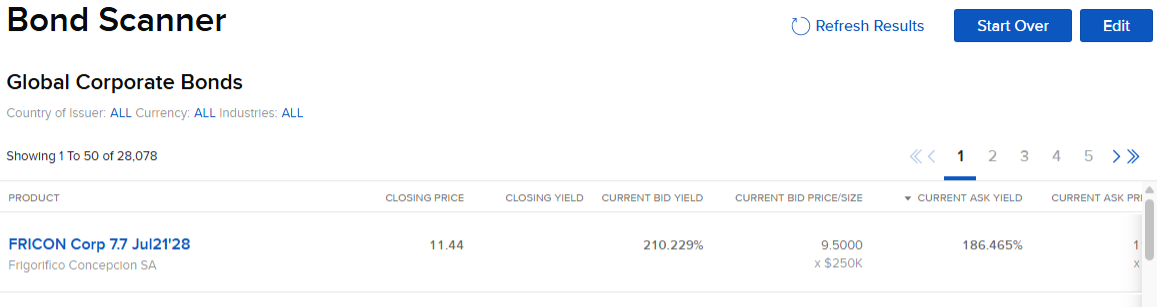 Step 2 — the results list after clicking View Results, with each bond’s closing price, bid and ask yields, and bid price/size.
 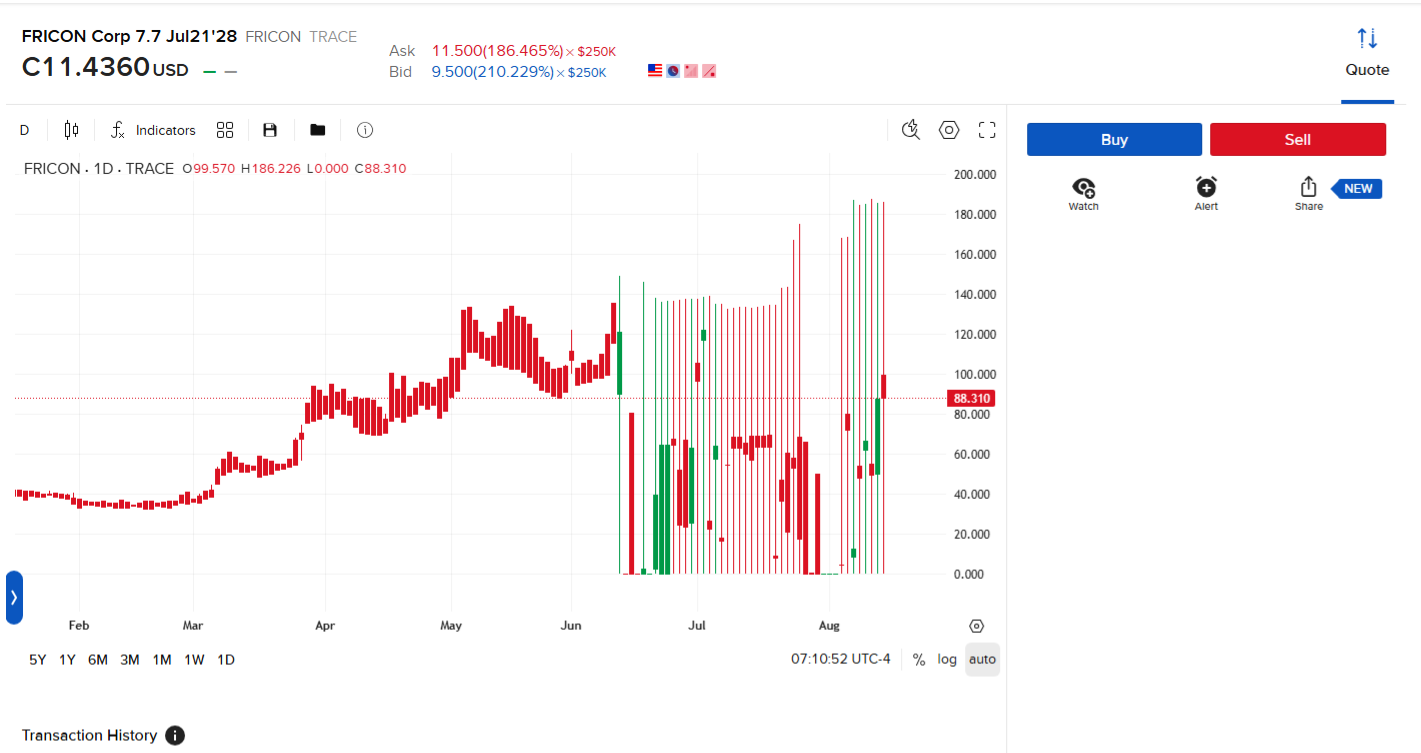 Step 3 — the instrument page: a price chart and the live bid/ask, with Buy and Sell on the right to open the order ticket.
 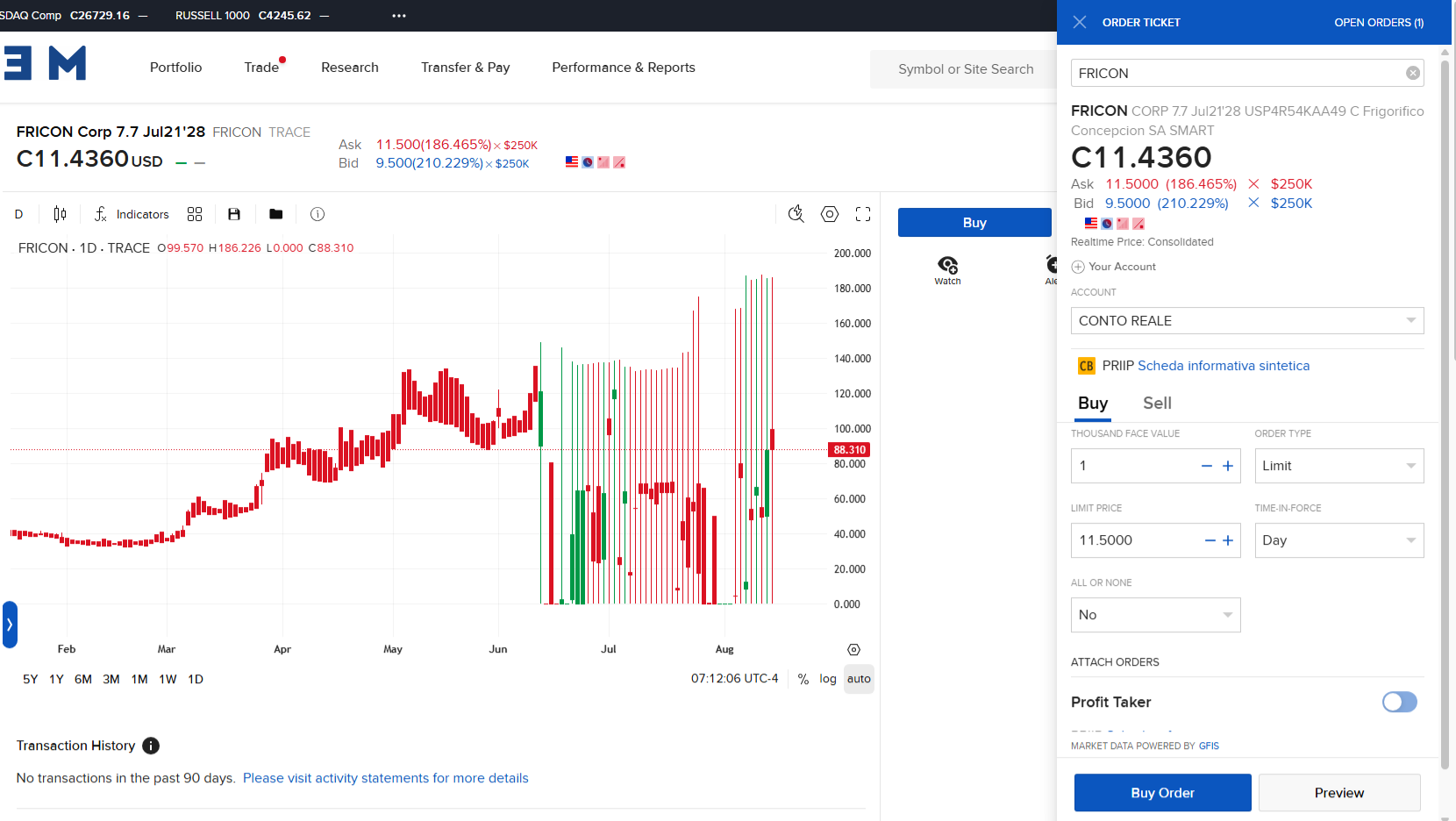 Step 4 — the order ticket: set the face value, order type (here a limit order), limit price and time-in-force, then Buy or Sell.
TWS is the power-user route. In the Global Bond Scanner window, right-click an instrument in the Results section and choose Buy or Sell; the order appears in the Orders panel, showing its account, action, quantity, time-in-force, order type, and destination (typically SMART) before you transmit it. If the Orders panel is hidden, drag the Scan Results divider down to reveal it. You can also drag a bond straight from the scanner into a watchlist to keep an eye on it.
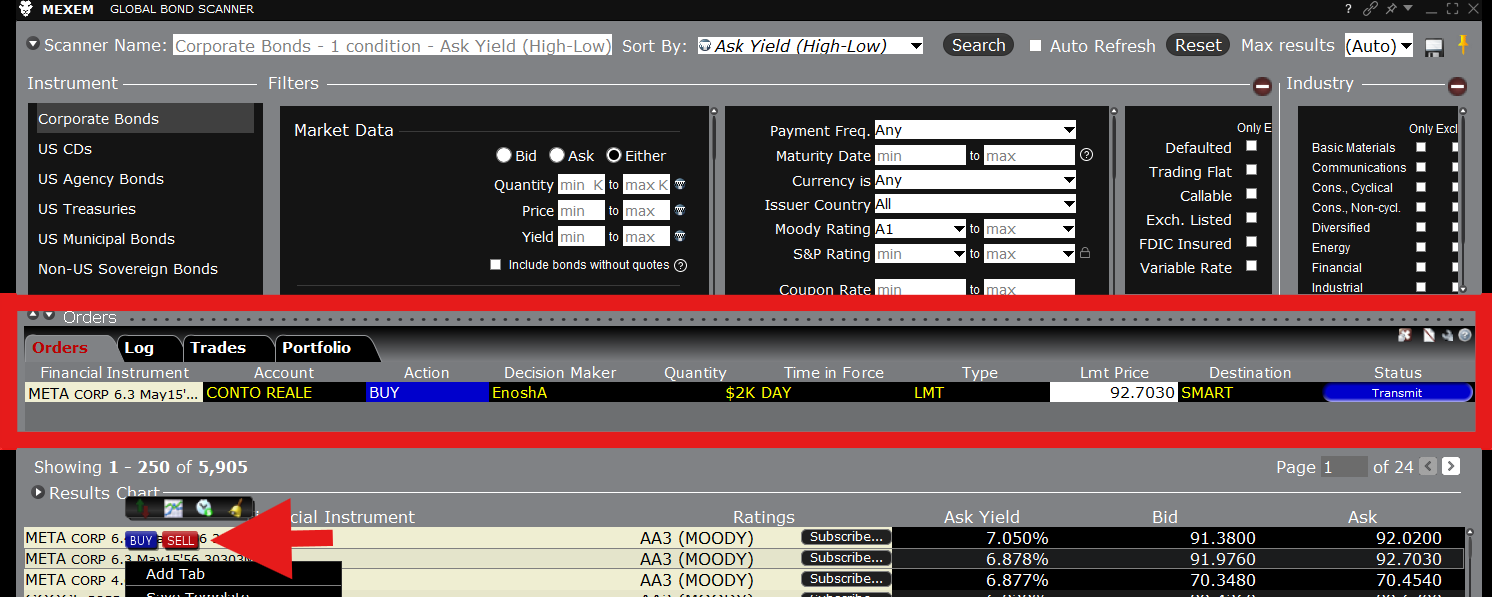 In Trader Workstation, right-click a bond in the scanner Results to Buy or Sell — the staged order lands in the Orders panel, here a limit buy routed to SMART, ready to transmit.
One limitation is worth knowing, inherited from the Interactive Brokers engine: the order ticket does not recompute a bond’s yield from the price you type in, nor does it show bond-specific analytics such as duration or spread at the point of trade. The scanner gives you yield-to-worst up front, but sanity-check the all-in yield of your limit price yourself before you submit — which is exactly where a pre-trade shortlist earns its keep.
It is powerful but technical. A seasoned investor will appreciate the depth; a first-time bond buyer will find it steep. This is a platform built for people who already know what a yield-to-worst is, not one that holds your hand while you learn.
MEXEM’s own contribution is the cushion: support in more than 10 languages, by phone, WhatsApp, and email, that direct Interactive Brokers clients do not get. It softens the learning curve without smoothing it away entirely — the interface still fits an experienced self-directed investor far better than a beginner.
Discovery runs through the inherited Interactive Brokers bond scanner, the tool that makes a menu of tens of thousands genuinely searchable. You can filter the universe by yield, maturity, credit rating, and currency, then drill into an individual issue’s yield-to-worst (YTW) — the lowest yield you could realistically earn if the bond is called early — before you commit. ISIN search pulls up a specific bond directly when you already know the one you want.
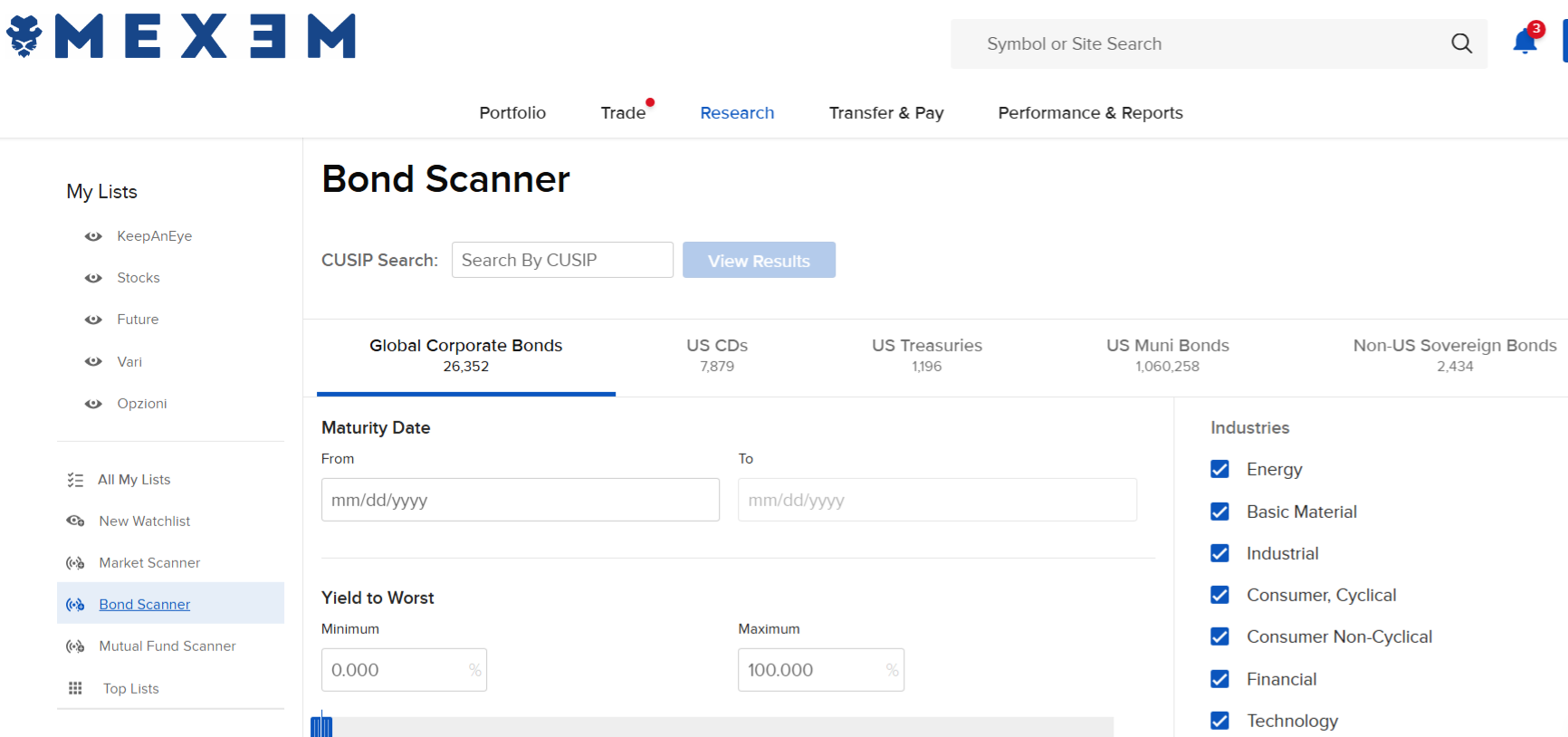 The MEXEM Bond Scanner in the Client Portal — filter by maturity, yield-to-worst, rating, currency and industry, with tabs for corporate, sovereign and other bond types.
The scanner separates the menu into bond types — global corporate, non-U.S. sovereign, and others — each showing its own live count, so you can see the depth in each bucket before you start narrowing by maturity, rating or industry.
This is where MEXEM’s depth becomes usable rather than overwhelming. The scanner is professional-grade, not a beginner’s filter, so it rewards investors who arrive with clear criteria — a target rating band, a maturity window, a currency — over those still deciding what they are looking for.
Positions are tracked in Interactive Brokers’ PortfolioAnalyst tool, with customisable, professional-grade performance reporting. The Holdings view breaks your portfolio down by asset type and asset class, measures return against benchmarks, and tracks net asset value over any period you choose.
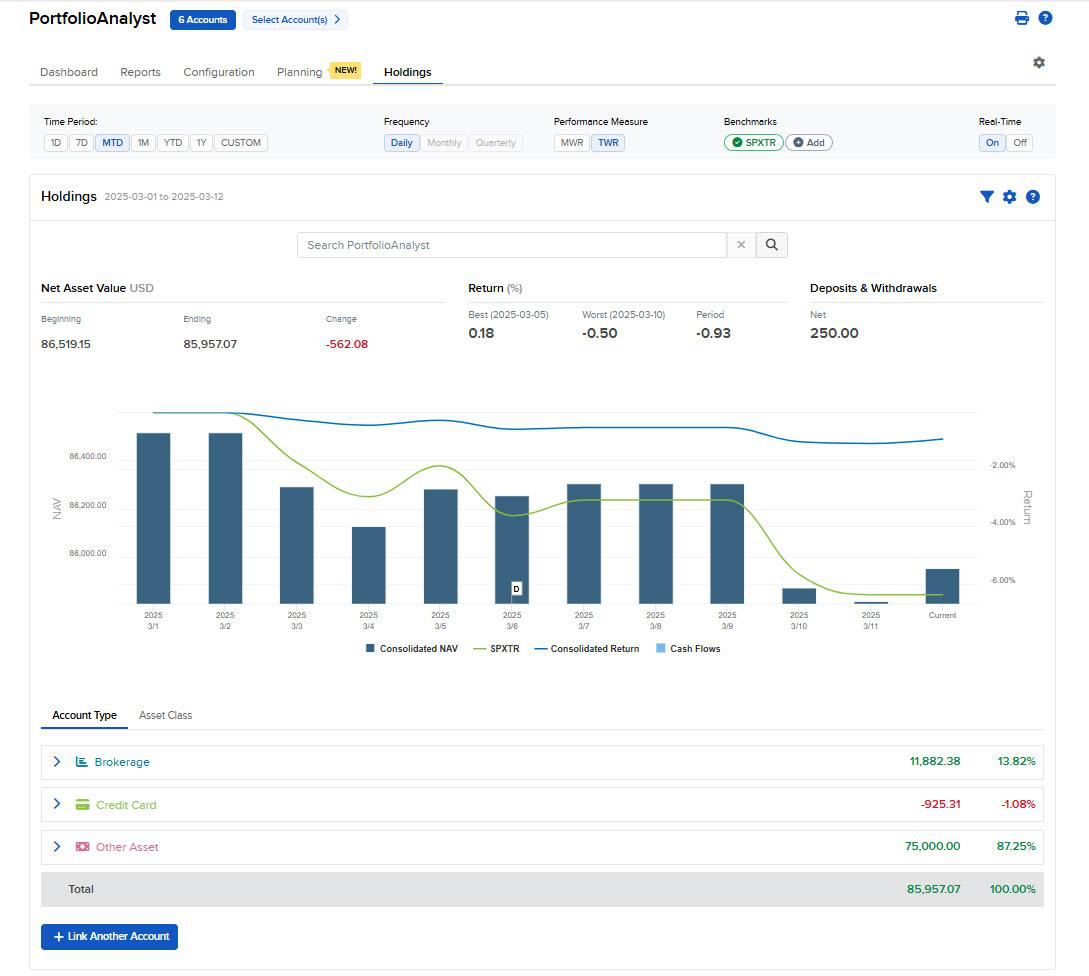 The PortfolioAnalyst Holdings tab — net asset value, return versus a chosen benchmark, and a breakdown of the portfolio by account type or asset class.
The Reports tab runs default or fully customised reports; a single snapshot can show cumulative return, key statistics, a distribution of returns, and long/short allocation by instrument and asset class — reported in your base currency, euro included.
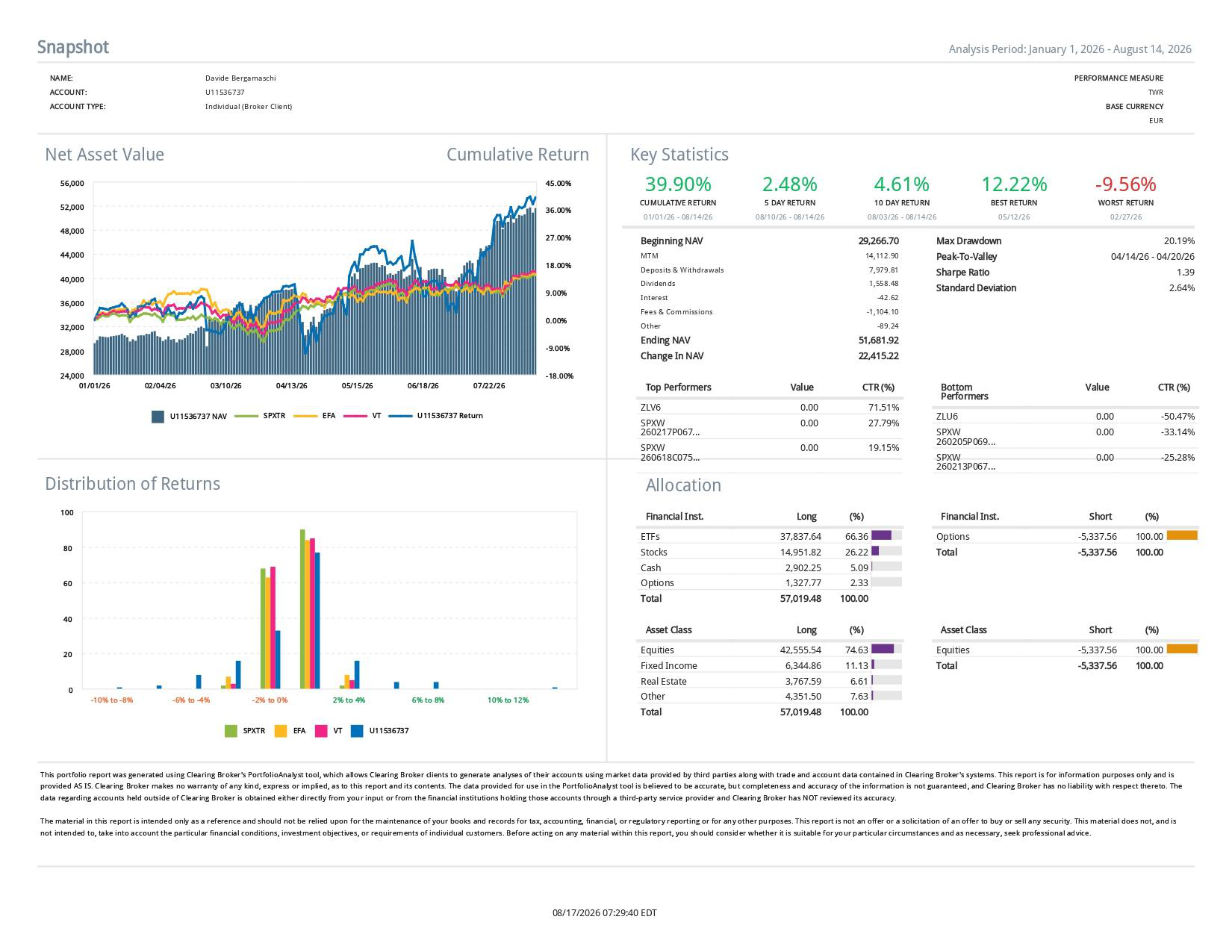 An example PortfolioAnalyst snapshot report — net asset value, cumulative return, key statistics and allocation by instrument and asset class, here in euro base currency.
The quiet standout, though, is tax reporting: localised, ready-to-use reports and assistance for markets including France, Spain, Italy, and Belgium, a Tax Optimizer for lot-matching, and dividend and withholding breakdowns by country. For an investor filing in an EU jurisdiction, that can save real work at year-end — and it is a large part of what the MEXEM service layer is actually paying for.
MEXEM fits the self-directed European investor who wants the widest bond selection and professional analytics, trades small-to-medium tickets, and is comfortable with a technical platform. It fits poorly for large single-bond orders, cash-interest seekers, and anyone needing a six-figure compensation backstop.